out, lim

Become a conscientious objector
WINTHROP, Maine — A 22-year-old veteran from Peaks Island, Maine who was granted conscientious objector status from the Army last November is taking to the Internet to share what he learned with others. Perry O'Brien, who served a tour in Afghanistan as an airborne medic before he was honorably discharged, on Saturday launched his online guide - http://www.peace-out.com - at a Winthrop Area People for Peace breakfast at the Winthrop Congregational Church.
"The Army doesn't make this information widely available, and many soldiers don't even know that the option of CO (conscientious objection) is available to them," O'Brien said. "This is a comprehensive, online resource for COs. We're already talking to three soldiers on how to avoid all the pitfalls."
Excellent work Perry. I salute you.
Peace OUT,
LIM
Peace-Out
File on 4: BBC tells how $9 billion was stolen from Iraq and Iraqis...
And here's George Monbiot's report in tomorrow's Guardian, Fraud and Corruption: Forget the UN. The US occupation regime helped itself to $8.8 bn of mostly Iraqi money in just 14 months
It proves companies of Halliburton's ilk behave like Saddam, stealing from the Iraqi people. Shame on you, shame on you. Each of you that benefit off the blood of innocent Iraqi women and children may be classified as walking abortions.
liminal
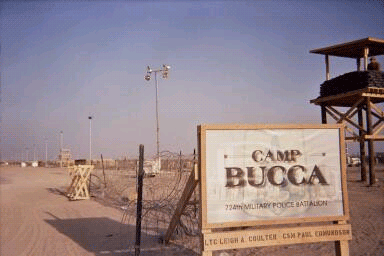
This Military Police officer gives her candid opinion of Iraqis at Camp Bucca in video-diary style.
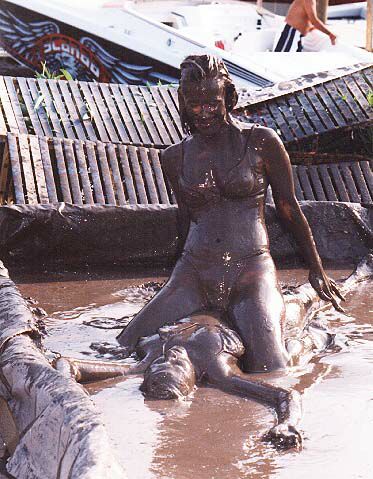
This is the 160th Military Police battalion handing over responsibiliity to the 105th at Camp Bucca on October 30th in Animal House style. (well, it is a re-enactment.)
Making Iraq look more like a frat party each and every day! Between Abu Ghraib's naked cheerleader pyramids to mud wrestling military policewomen, this is more like a sadist Animal House than the military service I would imagine including discipline and honor. The irony of it all. But really, excellent recruitment method for America's young and bored of GTA - San Andreas.
OUT,
lim
Inside Camp Bucca - A military policewoman's video diary
US Plans Were For $1 Billion Occupation Compound
If you tell a lie big enough and keep repeating it, people will eventually come to believe it. The lie can be maintained only for such time as the State can shield the people from the political, economic and/or military consequences of the lie. It thus becomes vitally important for the State to use all of its powers to repress dissent, for the truth is the mortal enemy of the lie, and thus by extension, the truth is the greatest enemy of the State.
Democracy is only an incubating idea when dissent isn't a part of its fabric. If it takes the master fascist propagandist taking the ills of existence with a crippled foot out on humanity to understand this unfortunate malaise we currently wad through, so be it. Sometimes I wonder if he'd have been a strong healthy blond Aryan, whether he would have been so effectively ruthless in his methods. I have the feeling with Geobbels that part of what drove him to succeed, if that's what you want to call it, was his fear of not belonging and his fear of being labelled a bourgeois intellectual who studied closely under a renowned Goethe scholar who happened to be Jewish, Friedrich Gundolf.
These are fascist times indeed. The lie that became common currency and led to the most recent war--and the one I can related quite intimately with this quote--was Iraq had weapons of mass destruction...even worse, Iraq had nuclear weapons. I wish the teachers of Bush Inc. were a bit smarter than Goebbels'. Ironically enough, it is by virtue of their stupidity that they are able to continue governing and not have to accept any responsibility for the mess they've made. Who are the teachers of this group anyway? Reality remains a forthought for their ilk...their likudnik ilk. And I have no reason to believe the sincerity of Condi or anybody in the administration's statements regarding Palestinian self-determination and statehood. Nor do I believe for a moment there will not be permanent bases in Iraq for the foreseeable future. And this will prevent true Iraqi self-determination. Please, at least be smart enough and read your history. I recommend Al-Wardi.
I'll be getting to the NY Times book soon. I've been a bit under the weather. Hope everybody's doing well.
out,
liminal

using an open source, copyleft model,
an experiment in practical gift economics,
a laboratory for new ways of releasing
music. Visit the Opsound Open Pool for
free copyleft music downloads. Musicians
and sound artists are invited to add
their work to the pool. Visit the Opshop
for copyleft releases on the Opsound Label.
Opsound: Open Sound Resource - copyleft music and sound
The Stink on the Stink of Abrams
A feminist mission?
"You go into Afghanistan, you got guys who slap women around for five years because they didn't wear a veil," Mattis said. "You know, guys like that ain't got no manhood left anyway. So it's a hell of a lot of fun to shoot them."

according to rumsfeld [via bbc]
Gonzales and Abrams appointed to Bush's cabinet
1. Alberto Gonzales : memo to the President about torture, so he condones torture, and Abu Ghraib!
2. Elliot Abrams : lied to congress, then pleaded guilty to withholding information about the Iran-Contra affair...um, criminal?...oh and he currently praises the hardline policies of the Israeli prime minister, Ariel Sharon.
Conclusion: Republican loyalty hurts America and the world.
Include the number of Iraqis civilian deaths in "Iraq: the Human Cost" section on MSNBC.com
MSNBC.com has a section called "Iraq: The Human Cost" http://www.msnbc.msn.com/id/3359080/ , ironically the list contains only coalition deaths during the war. We the undersigned think that all Humans are equal and when we count the human cost of this war we do not look at their passports.
We ask MSNBC to solve this by including the Iraqi civilian deaths in this list, We think that we should honor all who lost their life during this war, and more importantly those who are paying the price even though they are not fighting the war. That's what "Human cost is"
Include the number of Iraqis civilian deaths in the Human cost section of Iraq war on MSNBC.com
Something Special For My Iraqi and Near Eastern Brethren
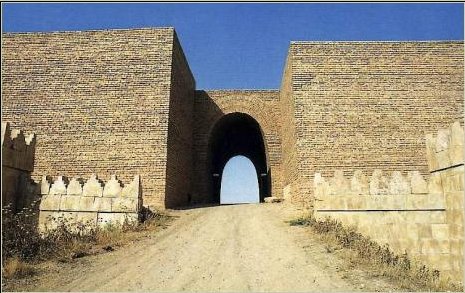
Masqah Gate, Nineveh
I'll do a translation of this once I start feeling better. It will put a smile on the face of practically all Arabic speaking persons. But I dedicate this to Iraqis. No matter how critical I may be on this blog, I have a great hope deep inside of me for Iraq and its future. And the only reason is because of Iraqis. If it were up to me, all of Iraq would become a world heritage site. But the people living and breathing right now are its most precious assets.
Anyway the poem you may download is a joke, sure. Ahmed Isma3el, the man with a 100% Iraqi accent drops some wisdom. And it is very sarcastic. He pegs the double standard about the Iraqi/Palestinian situation being committed by Al Jazeera. Namely about 1) elections 2) Human casulties: everybody thinks elections in Palastine is OK, but in Iraq its not. Meanwhile, both countries are under occupation!
Palastinians are martars, Iraqis are not. So he has chosen this way as a protest. But I don't agree with everything he says. In fact, I don't rather much like the statement about Americans being "liberators not occupiers". But it is still funny and so true in many regards.
So, enjoy and let me know what you think.
Here is the poem.
It's about 600k in mP3 format and worth every second of the wait. Right click and 'save link as' if you want a copy for yourself!
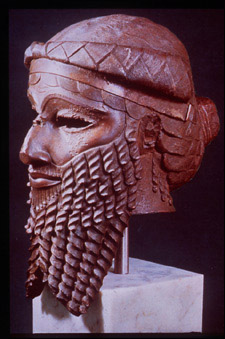
Looted Artefact (returned)
MY WAR: *** press release ***
G.P. Putnam's Sons to Publish U.S. Army Soldier and Blogger Colby Buzzell's War Experiences on the Ground in Iraq
Monday January 31, 2:46 pm ET
According to Esquire Magazine: 'The most extraordinary writing yet produced by a soldier of the Iraq war ...'
NEW YORK, Jan. 31 /PRNewswire/ -- G.P. Putnam's Sons is publishing the personal experiences of twenty-eight-year-old U.S. Army soldier Colby Buzzell. His book, My War, will offer uncensored stories that bring home the chilling realities of war. Buzzell's incisive reportage and brutally honest take on the war were first filed as entries in a web log, My War, that he created as a way to tell the world about what was really happening in Iraq. Buzzell's book will delve further into his personal experiences as a 20-something soldier in the line of fire.
Putnam will publish the book in hardcover in fall 2005, with a paperback edition to be published by Berkley in 2006.
Before enlisting in the Army at age twenty-six, Colby Buzzell (now twenty-eight) was living in California, jumping from one low-paying job to the next. He joined the military because he was "sick of living my life in oblivion." After he was deployed to Iraq, he quickly discovered that his life would never be the same again. On the ground near Mosul with First Battalion, 23rd Regiment, toting heavy weaponry amidst "guerilla warfare, urban-style," Buzzell was disturbed by how the war he was fighting was being reported - both by major news agencies and soldier-written blogs. In June 2004, Buzzell started his own blog, My War, and it offers a glimpse of his innate ability to chronicle the essence of war and its powerful impact on him and the world.
Mr. Highfill commented, "My War is already being compared by some early readers to the classics of combat and youth ... Heller's Catch-22 and Herr's Dispatches."
I wish you all the best Colby. Thank you for your candid and brilliant writing. PEACE and FTW, LIminaL
MY WAR: *** press release ***

Iraq rules out US troop pullout
Chalabi Cons His Way to the Top, Americans Don't Mind
* * * * * * * * *
This really is pretty incredible. From Jack Shafer's Slate column today, via Atrios:
[MSNBC Hardball host, Chris] Matthews: Wait a minute. When you say—Judy, when you say administration, do you mean the alliance party leadership or Allawi over there, the current prime minister? Who are you talking about?
[NYT reporter Judith] Miller: We are talking about the administration officials who have been reaching out to …
Matthews: You mean Americans?
Miller: ... [Ayatollah] Sistani's—yes, American officials who have been reaching out to Sistani's party. Because Dr. Chalabi is on that list.
Matthews: So where—so we have an election over there. And the same day we're holding an election, the same week, we are plotting which ministries to give to Chalabi, the guy who talked us into the war in the first place.
Miller: No, no. There were expressions. There was apparently an effort to determine whether or not he would be interested in assuming a certain portfolio.
Matthews: Why are we in the business of deciding or even negotiating cabinet ministries in a foreign government?
Miller: No. Well, you know, Chris, first of all, this is just one report. But I think what is very clear, according to people I talked to today, is that they have been attempting to mend fences with him. Now understanding that as a tent [phonetic transcription] on that Sistani list, the Shia list, he will be an important person in Iraq. And I think that there will have to be a lot of rethinking on the part of the Americans with whom they want to deal.
Matthews: … the idea that the man who won his country back through the vice president's office, Ahmed Chalabi, finds his way now through all this electoral process to end up as oil minister or finance minister, as you say, interior minister—and I think he has higher ambitions than that—makes the electoral process come down to the guy who started the war, ends up winning the war, irregardless of how people vote over there.
Miller: Well, you know, I think the interesting thing was the up and down, was the kind of rise and fall of Ahmed Chalabi in this administration. On one hand, in the beginning, he was the person supported adamantly by the Defense Department. He was opposed by the State Department and the CIA …
Matthews: Right.
Miller: ... who said he had no popular support in the country...
Matthews: Right.
Miller: ... and he wouldn't be able to hold a coalition together. We've now seen that, in fact, he played a pivotal role in putting together, helping to put together the list which we don't know yet, but it may very well have done extremely well, if not won the vote.
War and Piece:
Two perspectives on Iraq from RAND
By fighting terrorists in Iraq, does America reduce the likelihood it will have to fight them in the United States? It is an appealing idea to a nation that continues to worry about another 9/11, but on careful analysis the argument does not stand up.
Taking the fight to terrorists abroad — as America did by invading Afghanistan and by continuing efforts against terrorists worldwide — makes sense. But Iraq is a separate and special case, because many of the combatants killed or captured by American and allied forces in Iraq are insurgents created by opposition to the U.S. invasion itself. They have little to do with the jihadists that the United States has been actively hunting since 9/11, although some have been converted to al-Qaida's ideology since joining the resistance.
Iraq is not a geographic front line through which terrorists must pass physically to reach American shores. We are not heading them off at the pass. The jihadists and their recruiting reservoirs are dispersed throughout the populations of Asia, the Middle East, North Africa, Europe, and to a lesser degree North America. They are inspired by al-Qaida's ideology, but they are also fired up about local issues.
Fighting in Iraq is not so distracting to the jihadist enterprise that it is unable to prepare and carry out terrorist attacks elsewhere. Al-Qaida was never a highly centralized operation. Under intense pressure for the past 39 months, it has further decentralized. Local jihadist operatives are doing more on their own. Since 9/11, jihadists have carried out major terrorist attacks from Bali to Madrid, on an average of once every two months, not counting incidents in Russia or Iraq. The pace of terrorist operations has not slowed a bit since the invasion of Iraq.
True, some of the foreign jihadists who showed up to fight in Iraq might have been candidates for operations at home had there been no war. But their numbers do not appear to be great, and most are from countries adjacent to Iraq.
Taken literally, the argument that battling terrorists in Iraq averts battling them in America and elsewhere assumes there is roughly a fixed number of terrorists in the world. Following this logic, when U.S. officials say that three-quarters of al-Qaida's leaders have been killed or captured, or when they talk about the total number of terrorists detained worldwide, we could simply subtract this number from the ranks of those who are plotting to attack the United States and elsewhere. Unfortunately, this is not the case.
Counting terrorists is slippery business. The jihadist population itself is dynamic. Recruiting has continued successfully since 9/11 — some analysts believe it has increased as a consequence of the terrorist attacks. And opinion polls among Muslims suggest that growing antipathy toward the United States is expanding the jihadists' recruiting reservoir.
At the same time, terrorist losses are continuous. In addition to those killed and captured, some of those who went through the training camps claim to have decided right away that al-Qaida's brand of jihad was not for them. Others, no doubt, have dropped out in the years since they attended training.
Jihadists also vary in their level of commitment. Some are willing to serve as martyrs, while others are willing only to provide passive support, prompting terrorist leaders to complain of substandard zeal.
That leaves us with a terrorist population that is simultaneously expanding and eroding, and whose individual members are constantly recalibrating their level of commitment.
The “fighting them there, not here” school of thought makes sense if one conflates the threat posed by terrorists like Osama bin Laden with that of hostile tyrants with nuclear ambitions like Saddam Hussein. Although claims of a prior relationship between al-Qaida and Hussein have been largely abandoned, the argument assumes inevitable (if not demonstrable) links.
This is the core belief underlying the “global war on terror,” which views the proliferation of weapons of mass destruction and escalating terrorism as a single threat. It presumes that proliferating states — reluctant to use nuclear or other unconventional weapons themselves and risk retaliation — will hand the weapons over to terrorists, who are likely to use them against U.S. targets.
On his recent visit to Baghdad, British Prime Minister Tony Blair offered a more nuanced interpretation of the connection between the fighting in Iraq and the fight against terrorism. “If Iraq becomes a stable, democratic country able to defeat terrorism here [in Iraq] — which is the same kind of terrorism that we face the world over — if we can defeat it here, we deal it a blow worldwide,” Blair said. Putting aside the crucial “if” in the prime minister's statement — and forgetting for the moment that the current terrorism in Iraq is a product of the invasion itself — this argument sees terrorism in Iraq and worldwide as a single phenomenon that nonetheless can be dealt a blow in Iraq.
The most ambitious and optimistic proponents of the fighting-them-there thesis would reach further, arguing that only by profoundly altering the Middle East's political situation from failed states and corrupt tyrants to the stable, democratic allies envisioned by Prime Minister Blair can the United States ever hope to defeat terrorism. According to this line of thinking, political change brought about by armed might in Iraq will spread from Baghdad to Damascus, Tehran, Riyadh, Cairo and beyond.
Ironically, this is exactly the way the jihadists see the non-Muslim world, making no distinctions between U.S., Israeli, Indian, Serbian and Russian policies. And they similarly call for expansion of the jihad, urging their followers to fight now instead of waiting for the infidels to invade the jihadists' countries.
Some might even say, “Fighting the infidels in Iraq means not fighting them here.”
RAND | Newsroom | Commentary | Iraq: Not Terrorist Central: "Brian Michael Jenkins deflates the idea that battling terrorists in Iraq averts battling them in America
The Iraqi elections could consolidate support among Sunnis for the insurgency, increase violence and channel the fighting that results along ethnic and religious lines. That's because Iraq's present electoral system will award representation to each province based not on its population but on the number of voters who actually reach the polls. So Baghdad and the Sunni triangle will be at a serious disadvantage. Violence there is extraordinarily high and voter participation is likely to be correspondingly low.
It's probably too late to fix the Iraqi electoral system in order to make it more like that of the United States, but it's not too late to fix the consequences after the election. The new parliament and government can be adjusted to reflect the country's real population. Iraq can avoid escalating civil war if the upcoming elections are followed by negotiations for power sharing.
The Sunni and Kurdish minorities should be offered an enduring share in governance and they should have guarantees that the Shia majority cannot govern in an exclusive and discriminatory fashion. Sunni leaders should be offered positions in the government and additional seats in the legislature commensurate with their share in the population even if there's a low voter turnout in Sunni parts of the country.
This sort of power-sharing agreement ended earlier bloody civil wars between Christians and Muslims in both Lebanon and Bosnia. Unfortunately, the electoral results are likely to make such power sharing more difficult. They're likely to give the Shia an even larger majority in parliament and to make the Sunni an even smaller minority, but even so, moderate Shia leaders will have considerable incentives to share power. They want to hold Iraq together, they want to avoid a bloody civil war and they want to expedite an eventual American withdrawal. They cannot hope to achieve these objectives without some accommodation with the Sunnis.
The United States has a comparable interest in this outcome for exactly the same reasons, but maneuvering the Shia, Sunni and Kurdish communities toward that outcome will require an extraordinarily quiet and skilled diplomatic campaign. Some may accuse the United States of subverting the results of a free election. Others will say we're supporting the very community most opposed to our presence in Iraq, but the 60 to 90 days after this month's elections will be pivotal for Iraq's future.
If the electoral winners can be persuaded to share power with the losers, they will have a chance to convince a significant element of the Sunni community to support the government. Then moderate and democratic Iraqis will have a chance to hold their country together and to avoid the kind of ethnic cleansing and genocidal violence that we saw in Lebanon in the 1980s, in Bosnia and Kosovo in the 1990s and we see in Sudan today.
For the sake of everybody, let's hope the elections don't make things worse. I'd like to still think there is a small chance, if interactions are both precise and well-meaining, to save Iraq from a worse fate than the present state.
RAND | Newsroom | Commentary | Upcoming Iraqi Elections Could Make Ethnic Strife There Even Worse

Shakespeare and Depleted Uranium
Heat not a furnace for your foe so hot
That it do singe yourself.
William Shakespeare (1564-1616)
Here is a report in html or pdf, called US Nuclear Policy and Depleted Uranium given at the testimoney on June 28, 2003 of the Public Hearing for the International War Crimes Tribunal on Afghanistan and written by Leuren Moret, President of Scientists for Indigenous People, City of Berkeley Environmental Commissioner, and past president of the Association for Women Geoscientists.
In it I have found a source online that gives notice in 1991 about the use and effects of Depleted Uranium in the first Gulf War. It is used as support for this report. Go to the last page of the report where the bibliography is located to find the sourcing. Here is the classified memorandum from Los Alamos:
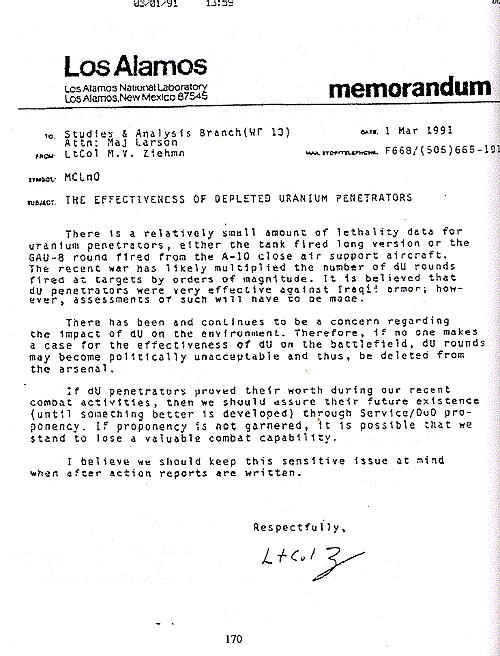
It's been 14 years. Do you think they've figured out whether or not Shakespeare is right yet?
Sami Ramadani: The Vietnam turnout was good as well
George Bush and Tony Blair made heroic speeches on Sunday implying that Iraqis had voted to approve the occupation. Those who insist that the US is desperate for an exit strategy are misreading its intentions. The facts on the ground, including the construction of massive military bases in Iraq, indicate that the US is digging in to install and back a long-term puppet regime. For this reason, the US-led presence will continue, with all that entails in terms of bloodshed and destruction.
In the run-up to the poll, much of the western media presented it as a high-noon shootout between the terrorist Zarqawi and the Iraqi people, with the occupation forces doing their best to enable the people to defeat the fiendish, one-legged Jordanian murderer. In reality, Zarqawi-style sectarian violence is not only condemned by Iraqis across the political spectrum, including supporters of the resistance, but is widely seen as having had a blind eye turned to it by the occupation authorities. Such attitudes are dismissed by outsiders, but the record of John Negroponte, the US ambassador in Baghdad, of backing terror gangs in central America in the 80s has fuelled these fears, as has Seymour Hirsh's reports on the Pentagon's assassination squads and enthusiasm for the "Salvador option".
An honest analysis of the social and political map of Iraq reveals that Iraqis are increasingly united in their determination to end the occupation. Whether they participated in or boycotted Sunday's exercise, this political bond will soon reassert itself - just as it did in Vietnam - despite tactical differences, and despite the US-led occupation's attempts to dominate Iraqis by inflaming sectarian and ethnic divisions.
Guardian Unlimited | Guardian daily comment | Sami Ramadani: The Vietnam turnout was good as well
TELL YOUR SENATOR, NO TO GONZALES
PACE,
LIM.
up the date:
Commercial being aired by moveon
Ad in NY Times:
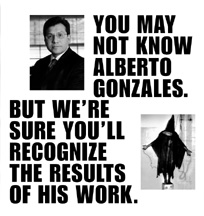
Latest on Alberto "Judge Torture" Gonzales:
German Prosecutor Asked to Investigate Gonzales Role in Abu Ghraib War Crimes
Quoted on the Beeb
Unfortunately, they didn't mention my blog's name. Perhaps because it's Maslawi slang? Oh well! I would have it no other way though! They did quote something quite appropriate. So that made up for it. One of my main messages in this blog is to make people aware it's not only very possible to be Anti-Occupation and Anti-Saddam at the same time, it is probably very much the mainstream-thinking in Iraq after all the terrible mistakes made. Excuse me if this is too much tooting of my horn, but I've stuck to my beliefs strongly for this long and I want to enjoy this slight moment! Here's what they quoted:
Still, let us hope for the best...even with all the American designs on Iraq, its oil, and the strategic influence of having 14 permanent bases inside Iraq.
And I'm both proud to be Iraqi and proud of Iraq today. Let us move forward together with pace. [Let's not allow or tolerate the injustices described above.]-[they edited this out, referring to the Robert Fisk report I had in the post] Let's demand for a more humane future for Iraq. Let us see the end of American occupation and the beginning of self-determination. I hope.
Here are some screen shots and the audio, don't forget:

Paul Mason the producer of the blog segment for Newsnight

Notice the crippled person walking and my quote, "...even with all the American designs on Iraq, its oil, and the strategic influence of having 14 permanent bases inside Iraq."

Notice the American tank and my quote, "Let us move forward together with pace."

Notice the tank again and my quote, "Let's demand for a more humane future for Iraq."
I think it's a bit of an eerie juxtaposition. This is how I see it. Until the occupation ends Iraq will be crippled on the path of self-determination. We will not be able to completely move forward with pace (and peace) nor have a more humane future until the tanks leave. Now watch Newsnight before it goes away tomorrow!
A little overboard, I know. But it feels nice to have one's voice heard.
oUT,
liminal
BBC Newsnight's Iraqi Blog Monitor Segment by Paul Mason, 31 January 2005
update: Self praise does not suit me. In fact, yuck...I was excited when it happened , now I would prefer to erase this post. Truthfully, I rock. But more truthfully, there are perhaps 50 bloggers who should be quoted on the BBC before I am. So, I am humbled by the attention. -lim
Zarqawi appears to vote

The ever elusive Abu Musab Al-Zarqawi appears at a polling place in Baghdad as an anthropomorphized donkey with the simple wish to vote. Yet he was turned away because he is a Jordanian national. After election officials realized they had just let the most feared terrorist in the world (besides Osama Bin Laden) slip from their grasp, American planes bombed deserted polling centers in his current suspected hideout, Ramadi, as collective punishment for allowing Zarqawi to galavant freely among what many residents describe as a "ghost town".
Iraq needs light to count the ballots!!!

In a vision of either romantic dedication or unfortunate irony, this election official is bound to ruin his eyes reading such small markings by candle light. If you want to save this man's eyes and secure a small part of Iraq's future, give more light to Iraq. Trading electricity for "democracy" wasn't part of the plan, I hope. I cannot wait until the day that I can take the quotation marks off democracy.
slideshow of Iraq Elections
Robert Fisk reports from Baghdad for the London Independent
This election will change the world. But not in the way the Americans
imagined - Robert Fisk: 29 January 2005
One man's belief in the triumph of good over evile should give us all hope
And I post all of the one from today. Also, there'll be another on the way.
We'll go on cheering 'democracy' - and Iraqis will go on dying 30 January 2005
In Baghdad yesterday, they were supposed to be preparing for an election. But they were preparing for war.
The American Bradley armoured vehicles on the streets, the US foot patrols, the old Russian personnel carriers that Saddam Hussein bought on the cheap from the Soviet Union - now dressed up in the dull camouflage paint of the "new" Iraqi army - the hooded and masked policemen; they don't look like the prelude to an experiment in democracy. They are waiting for the rivers of blood of which the insurgents have warned. But there will be democracy in Iraq.
The mortars rained down yesterday morning on the Green Zone where the US and British embassies are located. A "thumpety-thump-thump" brought the American Apache choppers over the surrounding highways in less than 30 seconds, but the insurgents had disappeared. Then a fierce gun battle broke out in the centre of Baghdad between Americans and insurgents. Too late again, the gunmen got away. Fantasy attacks before a fantasy election. Many Iraqis do not know the names of the candidates, let alone their policies. But there will be democracy in Iraq.
The media boys and girls will be expected to play along with this. "Transition of power," says the hourly logo on CNN's live coverage of the election, though the poll is for a parliament to write a constitution and the men who will form a majority within it will have no power.
They have no control over their oil, no authority over the streets of Baghdad, let alone the rest of the country, no workable army or loyal police force. Their only power is that of the American military and its 150,000 soldiers whom we could see at the main Baghdad intersections yesterday.
The big television networks have been given a list of five polling stations where they will be "allowed" to film. Close inspection of the list shows that four of the five are in Shia Muslim areas - where the polling will probably be high - and one in an upmarket Sunni area where it will be moderate. Every working-class Sunni polling station will be out of bounds to the press. I wonder if the television lads will tell us that today when they show voters "flocking" to the polls.
In the Karada district, we found three truckloads of youths yesterday, all brandishing Iraqi flags, all - like the unemployed who have been sticking posters to Baghdad's walls - paid by the government to "advertise" the election. And there was a cameraman from Iraqi state television, which is controlled by Iyad Allawi's "interim" government.
The "real" story is outside Baghdad, in the tens of thousands of square miles outside the government's control and outside the sight of independent journalists, especially in the four Sunni Muslim provinces which are the heart of Iraq's insurrection.
Right up to election hour, US jets were continuing to bomb "terrorist targets", the latest in the city of Ramadi - which, though Messrs Bush and Blair do not say so - is now in the hands of the insurgents as surely as Fallujah was before the Americans destroyed it.
Every month since Mr Allawi, the former CIA agent, was appointed premier by the US government, American air strikes on Iraq have been increasing exponentially. There are no "embedded" reporters on the giant American air base at Qatar or aboard the US carriers in the Gulf from which these ever-increasing and ever more lethal sorties are being flown. They go unrecorded, unreported, part of the "fantasy" war which is all too real to the victims but hidden from us journalists as we cower in Baghdad.
The reality is that much of Iraq has become a free-fire zone - for reference, see under "Vietnam" - and the Americans are conducting this secret war as efficiently and as ruthlessly as they conducted their earlier bombing campaign against Iraq between 1991 and 2003, an air raid a day, or two raids, or three. Then they were attacking Saddam's "military targets" in Iraq. Now they are attacking "foreign terrorist targets" or "anti-Iraqi forces". I especially like this one since the foreigners involved in this violence happen in reality to be Americans who are mostly attacking Iraqis.
And not only in Sunni areas. Just this month, for example, US aircraft fired missiles at a students' dormitory at the University of Erbil in the Kurdish north of the country. Among the wounded Kurds was a survivor of Saddam's gassing of Halabja - one of the reasons Mr Bush and Mr Blair supposedly invaded this wretched place. No explanations from the Americans.
So why were they bombing Kurds? To warn them that they will not be given independence? Or to stop them feuding over the city of Mosul, which "new" Iraq wants to keep inside the national territory, not surrender to some future "Kurdistan"?
Yes, I know how it's all going to be played out. Iraqis bravely vote despite the bloodcurdling threats of the enemies of democracy. At last, the American and British policies have reached fruition - a real and functioning democracy will be in place so we can leave soon. Or next year. Or in a decade or so. Merely to hold these elections - an act of folly in the eyes of so many Iraqis - will be a "success".
The Shias will vote en masse, the Sunnis will largely abstain. Shia Muslim power will be enshrined for the first time in an Arab country. And then the manipulation will begin and the claims of fraud and the admissions that the elections might be "flawed" in some areas.
But we'll go on saying "democracy" and "freedom" over and over again, the insurgency will continue and grow even more violent, and the Iraqis will go on dying. But there will be democracy in Iraq.
He highlights everything that frightens me so powerfully. Still, let us hope for the best...even with all the American designs on Iraq, its oil, and the strategic influence of having 14 permanent bases inside Iraq.
And I'm both proud to be Iraqi and proud of Iraq today. Let us move forward together with pace. Let's not allow or tolerate the injustices described above. Let's demand for a more humane future for Iraq. Let us see the end of American occupation and the beginning of self-determination. I hope.
Liminal
Ann Coulter Revisionist History of Vietnam on the CBC
Professor Juan Cole summarizes all my concerns
lim.
Informed Comment
BYE! Liminal
The turnout in Iraq was really like nothing that I had expected. I was glued in front of tv for most of the day. My mother was in tears watching the scenes from all over the country. Iraqis had voted for peace and for a better future, despite the surrounding madness. I sincerely hope this small step would be the start of much bolder ones, and that the minority which insists on enslaving the majority of Iraqis would soon realise that all that they have accomplished till now is in vain.
Confusion surrounds Iraq poll turnout
Confusion surrounds turnout statistics in Iraq's election, with the country's election commission backtracking on a statement that 72% had voted and top politicians insisting the turnout was high.
When I was hearing these numbers I was thinking, is my family the only one that didn't vote? How can this be? So this number is a "word-of-mouth estimate" actually. How can somebody give "word-of-mouth estimates" of this poll? That is one of the most ridiculous things I've heard in a while.
Confusion surrounds Iraq poll turnout

bbc dude: "Who are you going to vote for?
iraqi dude: Ayad Allawi.
bbc dude: Why are you voting for Allawi?
iraqi dude: Yaani, zain, kh'osh rijaal...[I mean, he's a good guy]
translator: He can control the government, the country...
Notice how the Iraqi dude didn't say a damn thing about "control[ing] the government, the country"...So, does Allawi's party have "special" translators giving scripted answers? Or does the translator not speak Arabic? WTF!
Anyway, like I said before...whatever.
out
sorry, but i was aware there were not supposed to be polling locations within the green zone. that's f'd up. you've got to be kidding me.
Draconian Elections Commence
I'm already in a frazzled and in an over-aware state.
I'm very confused about these state-of-emergency elections. Nobody can drive, dusk to dawn curfews...why erase one police state only to replace it with another? Chris Allbritton takes the words right out of my mouth. He's doing some live-blogging at the moment of the situation. Check him out.
In my disappearing post I was saying how I should check out arabic satellite tv to see what it all looks like, but he reports that they're only allowing five cameras in all of the polling stations (6,000 places). I mean, come on...
What a joke. These elections really are flawed, aren't they? This is how democracy is supposed to take root? Police state elections. Riiiggggggght, sure...
I fear these elections are only going to create more chaos and enmity within the local, confused populace. It certainly sets a bad example as to how democracy is supposed to work. But a whole lot of whatever...is all I can say at this point.
Let's hope nothing serious happens. But my gut gives me this eerie eerie feeling from far far away. And frankly, I'm horrified at what the possible ramifications of having this election like this will have on the future. For instance, what if Iraqis DON'T like the constitution that is formed? No matter if the elections were legitimate or not...what if this is the case? It could lead to something cataclysmic. And because things are already so unimaginably screwed up...and because I couldn't have dreamt up a worse situation to hold elections in...I've grown used to thinking about the worst possible scenario these days. Add an attack on Iran, and the freaks in D.C. have their armageddon. Knowledgable people around me are throwing predictions around, like: if the US attacks Iran, Iran attacks Saudi Arabia (and who else?) and sinks some ships in the gulf, halting any oil getting out of the region, bringing the entire global economy to a stand-still and crashing the dollar. And remember, Iran is not going to be a push-over like the dilapidated Iraqi army...even if they don't have nukes. But lets just assume they won't have them because the US would never attack a country with a nuclear weapon. As the North Korean case has proven...Anyway, something similar to this scenario could transpire and that freaks me out. I think the neocon "crazies" theory goes that they can attack Iran from the air and the people will then overthrow the mullahs. I don't buy it. It's complete bullshit if you ask me. And if these completely mad bastards are willing to risk it, they're inviting hell to dinner. You know that saying, "Don't shit where you eat?" Well, America is eating in Iraq right now. Until they leave the table, they'd be very poorly advised to shit on it any more than they already have. But I sincerely doubt the Bush administration will be leaving the table any time soon. I hope my gut is wrong...very wrong, in fact. I really do. Please let it be wrong, please...I need some sleep.
Peace on Iraq and Iraqis...
OUt,
Lim.
US and allies 'kill most Iraqis'
Coalition and Iraqi troops may be responsible for killing 60% more non-combatants in Iraq than the insurgents, the BBC has learned.
The civilian death toll for the last six months is contained in confidential records obtained by Panorama.
More than 2,000 civilians were killed by the authorities, while insurgent attacks accounted for 1,200 deaths.
Conflict-related civilian deaths in Iraq.
July 2004 to January 2005:
* 3,274 civilians killed in total
* 2,041 by coalition and Iraqi security forces
* 1,233 by insurgents
* 12,657 civilians wounded in total
* 8,542 by coalition and Iraqi security forces
* 4,115 by insurgents
BBC NEWS | Programmes | Panorama | US and allies 'kill most Iraqis'


The effect of the war and occupation on Iraqi Christians
There was a time shortly after the invasion, even as I was so angry and upset that it had taken place, when I dreamed of sweating and bleeding for Iraq and its future while staying inside Iraq. But exactly because of what Ghaith so eloquently describes in the following article, it is a dream that remains barely out of reach. Complicating things even further are the fact that I am an American that is still vociferously against this war and occupation. I hope the dream doesn't remain out of reach for much longer. Because I am still waiting to help Iraq in the hands-on manner inside Iraq when the time is right. Until then you will find me online and behind the scenes. Here is Ghaith now:
Bleeding the weak
Without political power or tribal muscle, Iraq's Christians have become ideal victims for gangsters and extremists. Many are now fleeing the country, says Ghaith Abdul-Ahad
Monday January 3, 2005
The Guardian
Yaqub Moussa sits in his liquor shop in Baghdad. One hand is hidden under the counter holding a black pistol, the other taps nervously on the surface. "People from the Hawza [the Shiite religious authority] come here every month; they take $100 from me every time. If I don't pay they say they will burn my shop because I am breaking the sharia Islamic law."
He looks at a teenage boy wearing a baseball hat and standing a few feet away from him. "Once I told them, 'I don't have any money and can't pay any more.' Next day my son was kidnapped and I had to pay them $500 to release him. This time I am going to kill anyone who touches my son."
What started as a campaign by religious extremists to impose sharia law in Baghdad and Iraq's other main cities, by attacking liquor shops, hairdressing parlours and music stores, has turned into a very lucrative mafia-style protection business.
Yaqub Moussa's shop is in Karrada, a prosperous neighbourhood of Baghdad, where Christians, Jews and Shiite Muslims have lived for centuries in an atmosphere of harmony. Fifty years ago the Jews were the first to feel religious tolerance dry up; most left for the new state of Israel in the 50s. Today, it is Christians who are feeling the pressure, which is forcing many of them to consider leaving too.
A few streets away from Moussa's establishment, in front of another liquor shop whose window frontage is completely covered by protective metal sheeting, stands a man with a badly tailored brown suit, a white shirt and a thin, neatly trimmed beard. Keeping his back to the shop, he scans the street.
Inside, another man, also in a badly tailored brown suit, but with a thicker beard and a big ring on his finger, stands in front of the counter questioning the son of the owner. "Where is your father?" he asks, in the tone of voice that used to be employed by Saddam's security police. "Call him, we have to talk to him."
"He is out, can I take a message?"
The frightened son is taken outside for a further talking-to, before the two men leave in a big white government SUV.
"They are from the security service of the Dawa party [one of the strongest Shiite religious parties]," the young man explains. "They come here every few weeks and we pay them. They are nice to us, they don't threaten to use force, but we know if we don't pay this place will be bombed the next day."
Christians in Iraq are divided into more than a dozen ethnicities and sects. Of the ethnic groups that exist within the country's borders today, the Chaldeans and the Syriacs are considered to be the oldest inhabitants. Joined by Assyrians, Armenians and Arab Christians they make up around 1.5% of the population, centred in Baghdad and the northern regions around Mosul, Dohuk and Kirkuk. Most of these groups are then divided between the Orthodox eastern church and the Roman Catholic church, but even the Presbyterian protestants have followers in Iraq.
Throughout Iraq's modern history, there has been little or no direct religious oppression of Christians, according to Father Bashar Wardeh, a priest in the Catholic Chaldean church in Baghdad and a teacher at the Babel Liturgical college. He argues that, unlike the Shiites and the Kurds, who opposed the ethnic-sectarian policies of the Ba'athist regime militarily and politically, the Christians never had political ambitions and so were tolerated by the regime.
Things started to change after the American led war of March 2003 that toppled the Ba'athist regime of Saddam Hussein. As chaos replaced dictatorship and oppression in Iraqi society, currents of religious fundamentalism - whether in the form of extreme Sunni Wahhabi militancy aimed at annihilating the "infidel", or attempts by Shiite clergy to impose a sharia ethical code - have been proving stronger than secularism. In this anarchic atmosphere, tribe, sect and ethnicity have become the natural shelters for people who feel that the state is unable to provide security for its citizens. As the Christians have no strong political or tribal weight, they have come to be perceived as the weakest element in the society.
"The Christian man will know who attacked him," says Father Wardeh, "but because there is no law to protect him and no tribe to go and take revenge for him, he will thank God for the loss and keep going."
In the office of one Christian political party - which agreed to an interview on condition of anonymity, fearing reprisals from Islamist extremists - more than a dozen young Christian men have been brought from their villages in the north to protect a party official. He sits in a dilapidated room in a former Ba'ath party office. "With the disappearance of the state, the tribal and ethnic elements became the major forces, which leads to government in which every post is awarded on a sectarian basis," he says. "The Christian citizen knows that the only way to participate in the process of rebuilding the country is to be adopted by this political party or that."
Many Christians find themselves obliged to affiliate with Islamic religious parties or tribes to get a degree of protection. After having a car crash, for instance, Sami Mansour, 57, a Christian taxi driver, sought the help of a local Shiite tribal council to solve the dispute. "When the other driver realised I was a Christian, he demanded not only that I should pay for the car repair but also that I should pay the tribal fine," he says. "I then went to a tribal council which agreed to talk on my behalf as one of their 'sons' and the other driver withdrew his claims."
Christians have seen their numbers falling dramatically in the past two years. In fact, they have been leaving Iraq in numbers since the mid-1990s. With the heavy impact of United Nations sanctions against the Ba'ath regime in power at that time, thousands of Iraqis began to flee. The Christians felt this pressure doubly: partly from the sanctions and partly from the resulting "Islamisation" of society. But a new wave of emigration has taken place in recent months, especially after a bombing campaign that began in August, targeting churches in Baghdad and Mosul.
In his house in a poor neighbourhood in eastern Baghdad, empty apart from couple of sofas and a plastic picnic table and chairs, Moris Illyas sits with his family to have their last Sunday meal in Iraq.
"There is no security here, a Muslim child can insult a Christian man and no one of us can say anything," Illyas says. He points to his 12-year-old daughter: "I stopped her from going to school. I used to take her to the school, wait outside for hours and then take her back. I can't stand that pressure any more."
Fear of verbal and physical intimidation caused his wife, Jaclin Shamir, to begin wearing hijab, covering her hair whenever she leaves the house to give her the look of a Muslim woman. "I have had to change my whole life. I now wear a scarf most of the time." Holding a golden crucifix in her hands, she says, "I hide this under my clothes now. It's like living in Rome in the early days of Christianity."
According to many priests, the numbers of churchgoers has fallen by more than half, and Sunday evening mass has had to be shifted to the afternoon because of security fears. Midnight Christmas masses were cancelled this year.
But Father Wardeh, whose church in eastern Baghdad is among those bombed, has refused to barricade the building with concrete blast walls or sandbags. "This is a house of God, and God shall protect it," he said as he watched the church's only guard patrolling the yard, an old man with a rusted Kalashnikov.
He is absolutely committed -- I don't know whether he thinks he’s doing God's will or what his father didn't do, or whether it's some mandate from -- you know, I just don’t know, but George Bush thinks this is the right thing. He is going to continue doing what he has been doing in Iraq. He's going to expand it, I think, if he can. I think that the number of body bags that come back will make no difference to him. The body bags are rolling in. It makes no difference to him, because he will see it as a price he has to pay to put America where he thinks it should be. So, he's inured in a very strange way to people like me, to the politicians, most of them who are too cowardly anyway to do much. So, the day-to-day anxiety that all of us have, and believe me, though he got 58 million votes, many of people who voted for him weren’t voting for continued warfare, but I think that's what we're going to have.
Democracy Now! | Seymour Hersh: "We've Been Taken Over by a Cult"
Here's a webcam up at the Cedars in Leb'naaaan! And here's one of the Jounieh-Beirut highway that I miss driving a million km/h on.
One should search throughout his whole life how best to follow the Way. And he should study, setting his mind to work without putting things off. Within this is the Way.

The danger of alienating the Sunni
'The US is behaving as if every Sunni is a terrorist'
For centuries they have comprised the ruling class, but since the fall of Saddam everything has changed for Iraq's Sunni Arabs. This weekend's elections are likely only to reinforce their disaffection.
Food shortages in Iraq
By Abed-latif al-Mawsawi
Azzaman, 2005-01-16
Besides security concerns, Iraqis now have to grabble with a shortage of basic foods.
The quality and quantity of state-supplied food rations has worsened recently and many Iraqis say they now receive less food than during the days of former President Saddam Hussein.
Iraqis have depended on monthly rations since the Saddam Hussein era, under a system meant to lessen the impact of the 1990-2003 U.N.-imposed sanctions that helped destroy the economy.
The Trade Ministry has acknowledged that supplies of basic items are low but blames logistics and lack of security for the shortages.
Prices of bread, the mainstay for millions of families, have skyrocketed recently to levels unseen before.
A loaf of bread in Baghdad is now sold for 100 dinars from 25 a year ago.
To allay fears of further shortages, Trade Minister Mohammed al-Joubori re-affirmed government’s commitment to continue supplying Iraqi families with subsidized food rations.
“We have no problem with tea and the contracts we have signed are sufficient for five months,” he said in a statement faxed to the newspaper.
He said 14,000 tons of ghee were on their way to the country from neighboring Syria and Jordan.
“I do not think there will be a shortage of legumes with 5,000 tones expected to arrive by the end of the month,” he said.
Joubori attributed the shortages to logistics, saying “long convoys” of trucks packed with food items were queuing on border posts.
Insurgents attack trucks plying Iraqi highways. As a result transport prices have surged at a time many drivers are reluctant to work for the government.
The climb in prices of bread is also partly due to acute fuel and power shortages as most bakeries in the country either rely on electricity or kerosene.
Many Iraqis did not get their monthly allocations of sugar rations of 2.5 kilograms per person.
“The Ministry (of Trade) will try to make up for the shortage of sugar this month,” Joubori promised.
The monthly food rations are vital for millions of Iraqis. Without them many will starve in Iraq."
Reading from...

On May 26, 2004, the New York Times issued an apology for its coverage of Iraq's weapons of mass destruction. The paper conceded that it had not investigated its WMD sources thoroughly, and, as a result, had printed articles that inaccurately assessed Iraqi WMD capabilities. In short, the Times failed to provide what most reader expect from the US newspaper of record: journalistic accuracy and integrity about important matters of US foreign policy.
But the Times' coverage of Iraq was worse than they were willing to concede. For example, in over seventy editorials on Iraq prior to the invasion, the editorial page never discussed or even mentioned international law or the UN Charter in the context of the Bush administration's threatened invasion of Iraq. In fact, for at least the past fifty years the editorial policy of the Times--from its coverage of the 1954 Geneva Accords on Vietnam to Iraq today--has failed to incorporate international law into its coverage of US foreign policy. This lapse, as the authors demonstrate, has had profound implications for the quality of the Times' journalism and the function of the press in a country supposedly governed by the rule of law.
In this meticulously researched study, Howard Friel and Richard Falk reveal how the Times has consistently misreported major US foreign policy issues, including the bombing of North Vietnam in response to the Tonkin Gulf and Pleiku incidents in 1964-65, the Reagan administration's policy toward the Sandinista government of Nicaragua in the 1980s, the 2002 military coup that briefly overthrew Hugo Chavez, Venezuala's elected president, and the Bush administration's 2003 invasion of Iraq.
In their analysis of the Times' coverage of Iraq, the author's analyze the specious legal and policy arguments given to support the invasion, the claims of Iraqi WMD, the Times' use of Ahmed Chalabi as an Iraqi WMD source dating back to 1998, the US cluster-bombing of Baghdad and the Iraqi town of Hilla, and a lengthy New York Times Magazine cover story that appeared to advocate the abuse and inhumane treatment of detainees that was published just as the Abu Ghraib story was breaking.
Friel and Falk's eloquent and damning book concludes by proposing an alternative editorial policy that incorporates international law into the Times' coverage of US foreign policy, which, they argue, would improve the news and editorial products at the Times while aligning its editorial mission with the defense of constitutionalism and the rule of law in the United States.
An introduction to the book as I prepare to take you inside what I deem to be the most interesting parts.
Once again, it was written and researched by Howard Friel, founder and president of Differentiated Information, Inc. (www.diffinfo.net), and author of Dogs of War: The Wall Street Journal Editorial Page and The Right-Wing Campaign Against International Law & Richard Falk, the Albert G. Milbank Professor Emeritus of International Law and Practice at Princeton University. Dr. Falk has also written Unlocking the Middle East and The Great Terror War.
Baghdad Burning, the Book

Everybody please buy her book immediately. Available on Feminist Press. (via Keld)
Baghdad Burning, Feminist Press
Iraqi Candidate Speaks to the BBC
I CAN'T TELL ANYONE I'M A CANDIDATE
Posted by Zeina Baghdad, 24 January
As a candidate in the election, I can't do that much. I'm afraid to give you my full name because if people opposed to the election find out they may come to the house and kill us. I can't tell strangers that I am running in the election. Our party, the National Democratic Party, has more than 300 members and about 30 candidates in the election, half of whom are women.
Conditions in Baghdad at the moment are very poor. There is little electricity or gas, we have to queue for hours to get just a little bit of gas for our cars. As you know, in Baghdad there are daily bombs and many people are being killed.
You see posters of the candidates for the main parties all over Baghdad. You can even run into some of these publicly declared candidates at private meetings, but they have heavy security. You never see them on the streets, meeting voters and campaigning in the normal way. It's just not safe.
It is hard to be a candidate in this election. I do go out and meet people, but most of them are relations or friends or colleagues, one way or another. I hope nothing terrible happens on election day. People are praying it will go smoothly.
I think it will also be hard for people who want to vote. People will be afraid to go to the polling stations, and given the difficulty of campaigning, people just don't know who they are voting for. But I and all my family will be voting - I think we can vote near where we live in the centre of Baghdad. I'm desperate to vote. I want a better future for my country and this will help.
I also think that Sunni Muslims in Iraq will change their minds and vote. They want to but are being intimidated. If they don't vote, they will not be represented at the centre of power and this in itself will cause problems. Unity, against the killers and bombers, is the key for Iraq as a whole.
As for the US soldiers, for the time being it is good that they stay. Without them the situation would be terrible. But, long term, they must leave.
I am a housewife at the moment, but I used to be a librarian. If I am elected, my priority will be to change the situation of children in our society. At the moment few have schools, or anywhere to go to play safely. That's my main election promise - to work to improve life for children.
The Age of Thinning Accountability
Next it's going to be, "The robot did it!" Are there any laws governing the use of robots on the battlefield?
BBC NEWS | Americas | 'Robot soldiers' bound for Iraq
A fresh beginning...
In the short term I've decided to take a look at a few books in detail in a new post feature called Reading from...
I'm going to do a re-review of Gillo Pontecorvo's 1966 film, The Battle of Algiers. I've recently purchased the Criterion Collection edition of this film. After sporting my bootleg version for a few years and reviewing it in a Manny Farber style last year, I think this new version with all the goodies in two additional DVDs is going to provide for a much more interesting review. Some of the additional material is 1) A 37 minute documentary narrated by Edward Said 2) a documentary that includes interviews with the director, cinematographer, composer, editor, actors, and film historians 3) Five Directors: a short documentary with acclaimed directors Spike Lee, Mira Nair, Julian Schnabel, Steven Soderbergh, and Oliver Stone on the film's influence, style, and importance 4) États d'armes: a documentary excerpt featuring senior French military officers recalling the use of torture and execution to combat the rebellion 5) The Battle of Algiers: A Case Study: Richard A. Clarke who is famous for speaking out against the Bush administration as former national counterterrorism coordinator and author of Against All Enemies: Inside America's War on Terror is featured in this short documentary where he discusses the films's relevance with Michael A. Sheehan, former State Department coordinator for counterterrorism, in a conversation moderated by Christopher E. Isham, chief of investigative projects for ABC News 6) Gillo Pontecorvo's Return to Algiers: the filmmaker revisits the Algerian people after three decades of independence. There's more, but that's a few of the other things I'll be writing about.
Also, I'll be doing a review of Abbas Kiarostami's film Ten. If you're not familiar with him, he's one of the most acclaimed Iranian directors. Kiarostami is famous for Taste of Cherry and Through the Olive Trees. In Ten he explores the nature of the Iranian woman's intricate sexual and social politics with a digital dashboard camera capturing video of eavesdropped conversations with various female passengers. The result is a fascinating collage displaying the complexities of modern Iran through the female lens. I'll do my best considering I'm a lowly male. [update: I might review Taste of Cherry in addition, since Ten is so sparse and conceptual.]
My Reading from... segment will begin by addressing the classic books of the martial arts of Asia. I'll do the Hagakure by Yamamoto Tsunetomo, The Book of Five Rings by Miyamoto Musashi, and others I've yet to decide on. Perhaps I'll just begin with typing out my favorite entries. Sometimes I'll offer some commentary, sometimes not. These books are centuries old, so you can read along with me if you click the links to the left.
And finally, for the political part of the fresh beginning...I'll be reading from The Record of the Paper: How the New York Times Misreports US Foreign Policy. This is a fascinating look at the NY Times. A newspaper I blame heavily on going a long way to justify the war on Iraq because of its famous role of being the paper of record. It was written and researched by Howard Friel [founder and president of Differentiated Information, Inc. (www.diffinfo.net), and is the author of Dogs of War: The Wall Street Journal Editorial Page and the Right-Wing Campaign Against International Law] and Richard Falk [the Albert G. Milbank Professor Emeritus of International Law and Practice at Princeton University. He's also written Unlocking the Middle East and The Great Terror War]. It's exhaustively researched and eloquently damning. I'll be putting up excerpts and then commenting on them with emotional and factual detail.
I hope this exercise in restraint and focus will carry me out of this terrible writer's block. I'll do some emotional ranting, too. But it will be less of a feature and more sharp than before...again, I hope!
If not, at least it will be both interesting for you (I hope! ;) and I.
I feel good about curbing my criticism of the Bush administration (most of the time), and focusing on how sick the NY Times paradigm makes me feel. I'll have ample chance to lay-into disgruntled, delusional, passive and patronizing leftists, too. Muah ha ha haaaaa!!!
The small irony of having to slam the Times in this fashion is that I really appreciate the work of some of its reporters and editorialists, like Maureen Dowd, Bob Herbert, Paul Krugman, and especially Nicholas Kristof...all thoughtful lefties. I've got a big soft spot in my heart for Nick (hahaha, inside joke). But I really think it's a dangerous newspaper that needs to change to reflect reality if American foreign policy is to be represented in news print with any sort of integrity. Otherwise, it is just serving the neocon idealogues in the Bush administration more than it is serving the greater portion of liberal-thinking Americans.
Anyway, yada yada...
I'll slip away now, watch Ten again, and cook up something tasty.
Much peace everybody!
Lim.
Zeyad has put up some very useful maps!
I told you I love maps ;) !
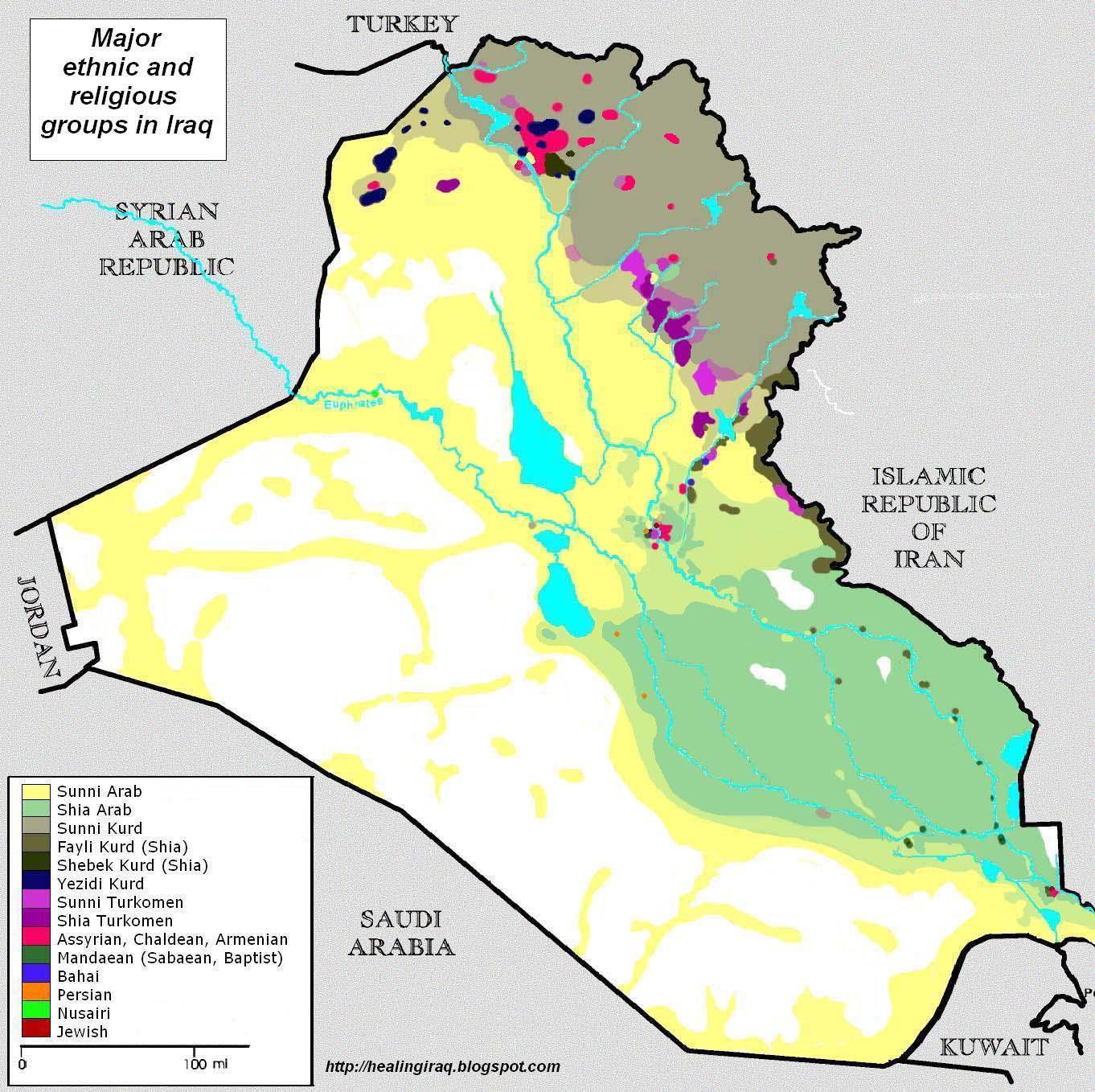
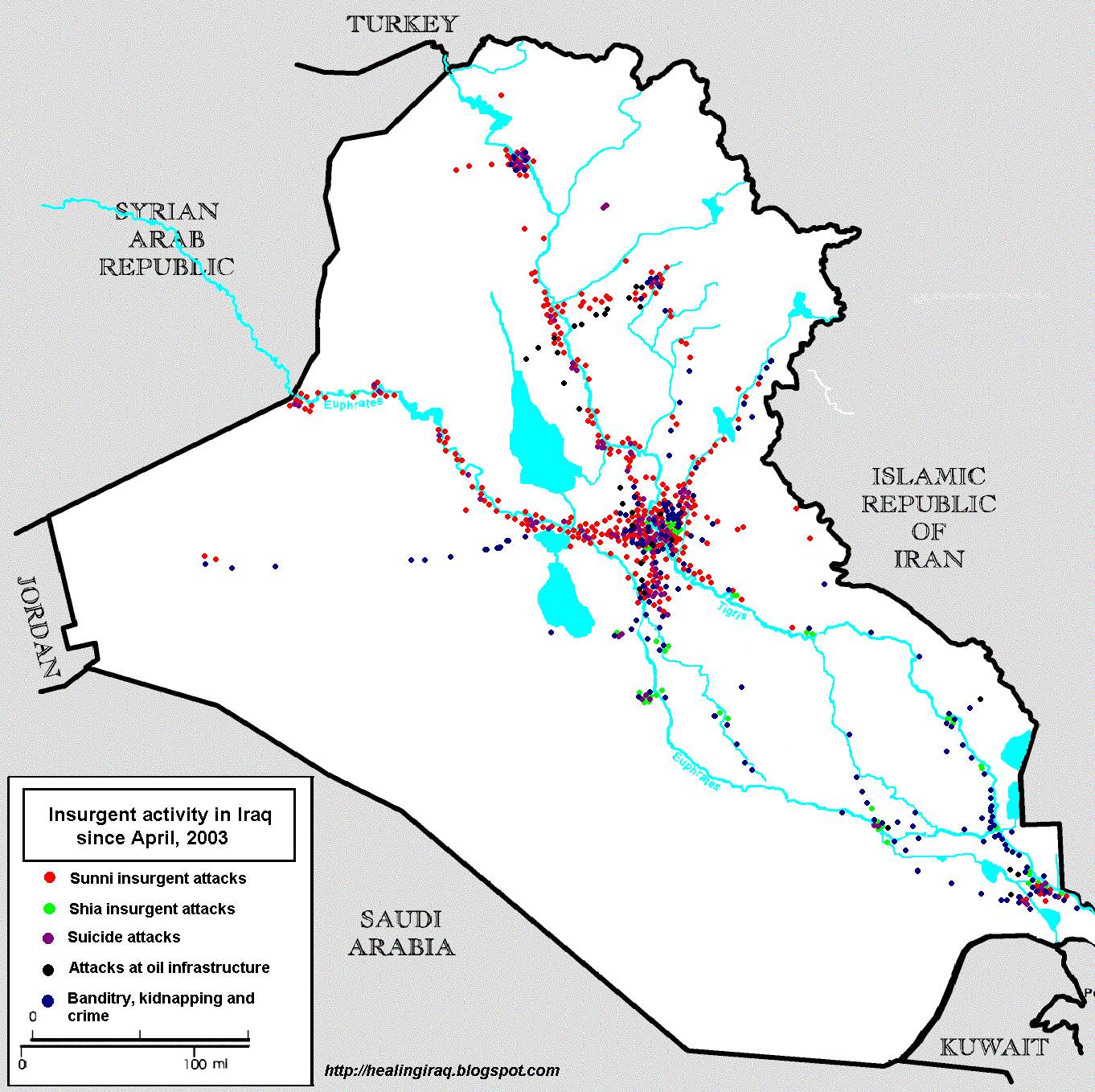
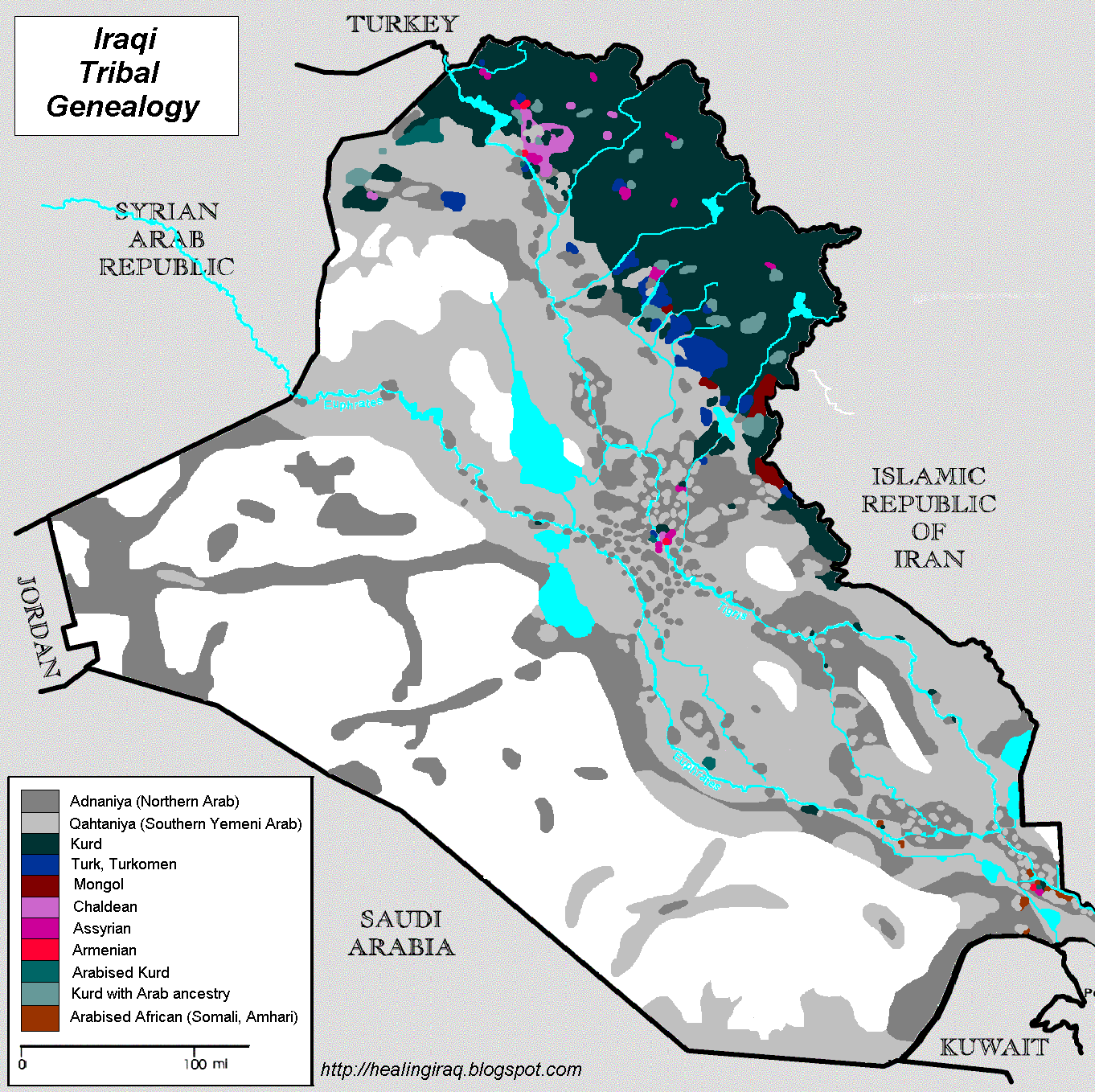
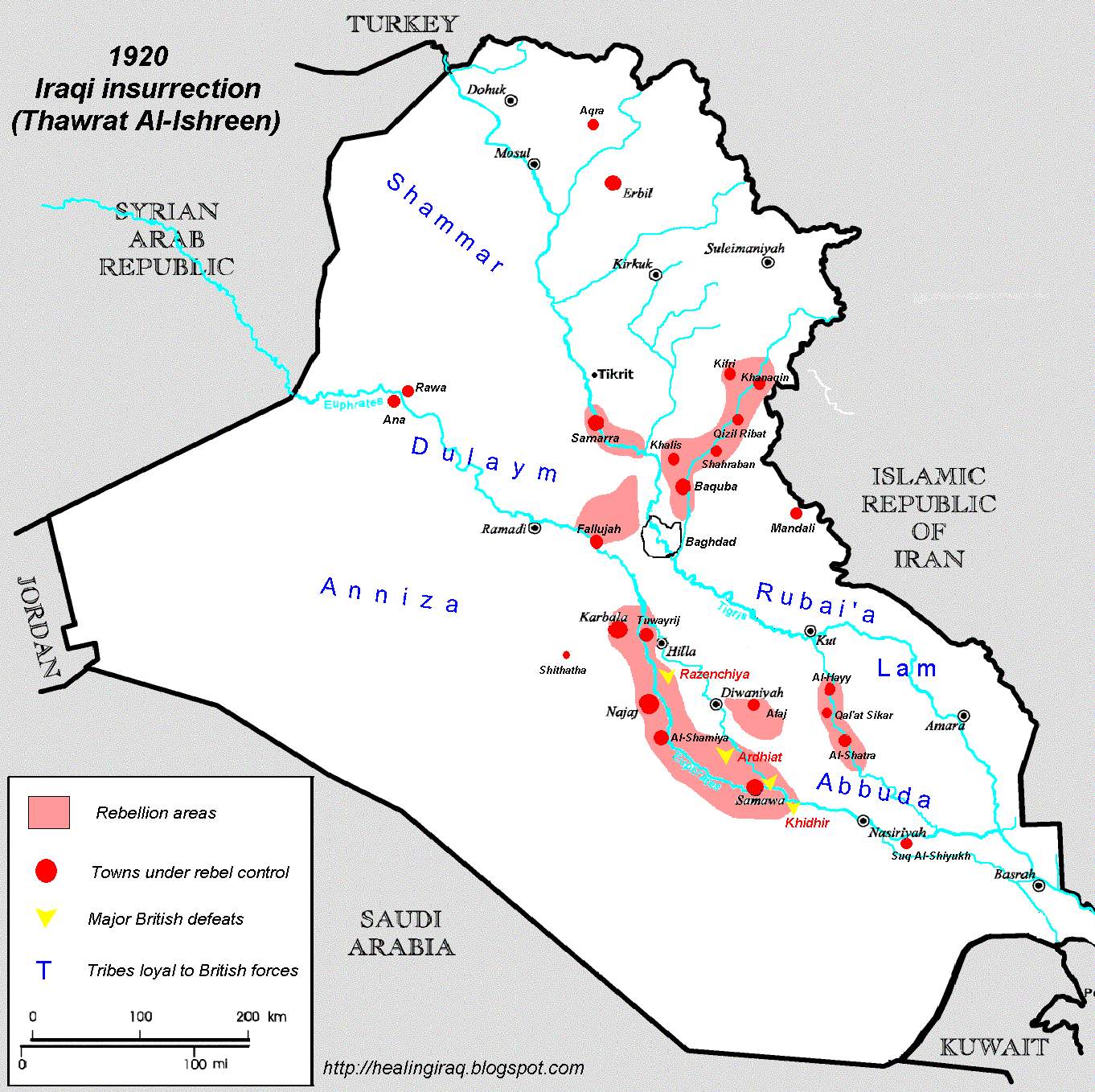
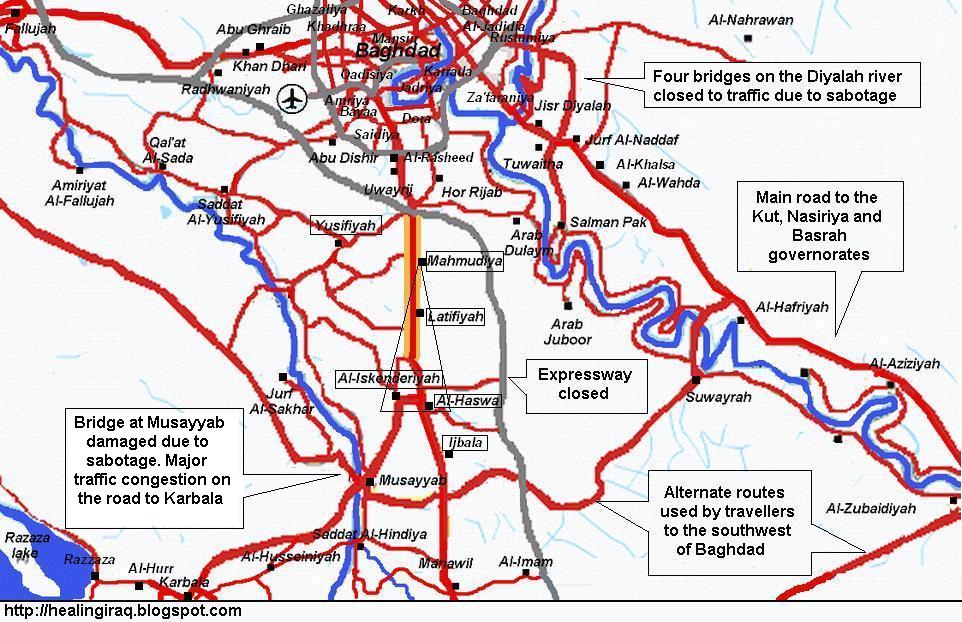
Now go visit Zeyad and tell him how much you love him!
And if you wish, just put drag the map to your desktop to get a bigger version. I've scaled them down using html so they fit on the page better. Enjoy meditating on the information!
Healing Iraq
Un Regard Moderne - The best way to be informed

Un Regard Moderne - Edition du lundi 17 janvier 2005
Proof that an Iraqi's life is not worth the same as an American's in the eyes of the occupier
In America you could be executed for shooting somebody in the head. Ask George...He knows a little bit about executing prisoners in his time as governor of Texas. And unjust policies that move away from the more civilized world's trend for abolition of capital punishment are the Prez' bread and butter.
"In a statement, the military said Specialist Charley Hooser of the 1st Cavalry Division was sentenced to three years in jail after being convicted of one count of involuntary manslaughter and one count of making a false statement.
'The convictions stem from an incident on November 24, when Hooser killed an interpreter, shooting her in the head,' the military said late on Saturday.
'Later that day, he made an official statement with the intent to deceive, denying involvement in the death of the civilian interpreter"
A killer joke
On the day of the incident, Dajani and 28-year-old Luma, whose full name was not disclosed, were in a room at an American base, joking about killing someone, the soldiers testified at the court martial hearing.
Dajani handed a handgun to Hooser, who thought it had been cleared and pulled the trigger as he held it to the young woman's head. The two GIs then lied to investigators, claiming that Luma had shot herself.
The woman had worked as a translator for The Washington Post daily before taking a job with the military.
Several US soldiers have been sentenced or are awaiting court martial in Iraq for their role in the killing of Iraqis. The scandal over abuse of prisoners at Abu Ghraib jail by US troops has also sparked widespread outrage.
Aljazeera.Net - US soldiers slapped on the wrist for Iraqi woman's killing
The New York Times > Opinion > Op-Ed Columnist: Divided We Stand