Idiots Rule
Pathetic considering there are actually people out there qualified to perform such jobs. But again, as its the rule more than the exception in the Cheney administration...you musn't be qualified. You must only be a friend, or a friend of a friend in the case of "Brownie".It sounds more like a Vince Vaughn-Owen Wilson flick than the story of a man who was to be responsible for the fate of the Republic during the biggest natural disaster in our history. Brownie was a failed former lawyer with a degree from a semiaccredited law school, as The New Republic put it, when he moved to Colorado in 1991 to judge horse judges for the Arabian Horse Association.
He was put out to pasture under pressure in 2001, leaving him free to join his pal Mr. Allbaugh at an eviscerated FEMA. Mr. Allbaugh decided to leave the top job at FEMA and become a lobbyist with clients like Halliburton when the agency was reorganized under Homeland Security, stripping it of authority. Why not, Mr. Allbaugh thought, just pass this obscure sinecure to his homeboy?
Time magazine reported that Brownie's official bio described his only stint in emergency management as "assistant city manager" in Edmond, Okla. But a city official told Time that the FEMA chief had been "an assistant to the city manager," which was "more like an intern."
Whoring out responsibilities of the state to witless lackeys like Brownie is hallmark of the current administration. So, not only if you fail do you receive medals and promotions...but you don't even need half a serving of credentials when serving in a position of prominence.
It's like appointing Elliot Abrams to be the Pentagon policy chief on the Middle East...
Oh, they've actually done that too.
Musical reference:
Jane's Addiction: Idiots Rule (mp3 up later, when my comp. recovery is complete)

Barbara Bush: "What I'm hearing, which is sort of scary, is they all want to stay in Texas"
Barbara Bush Calls Evacuees Better Off
WASHINGTON, Sept. 6 - As President Bush battled criticism over the response to Hurricane Katrina, his mother declared it a success for evacuees who "were underprivileged anyway," saying on Monday that many of the poor people she had seen while touring a Houston relocation site were faring better than before the storm hit.
"What I'm hearing, which is sort of scary, is they all want to stay in Texas," Barbara Bush said in an interview on Monday with the radio program "Marketplace." "Everyone is so overwhelmed by the hospitality."
"And so many of the people in the arena here, you know, were underprivileged anyway," she said, "so this is working very well for them."
Mrs. Bush toured the Astrodome complex with her husband, former President George Bush, as part of an administration campaign throughout the Gulf Coast region to counter criticism of the response to the storm. Former President Bush and former President Bill Clinton are helping raise money for the rebuilding effort.
White House officials did not respond on Tuesday to calls for comment on Mrs. Bush's remarks.
Saddam Mubarak wins more dictatorship for Egypt
...polling stations in Cairo visited by Western reporters yesterday were evidently geared towards ensuring voters cast ballots only for President Mubarak rather than Ayman Nour, the liberal lawyer who is the leading opposition candidate.
While supporting dictators has become less popular in the twisted muckery of global politics, Saddam Mubarak has defied the odds of survival and continues to collect bribery from the American government in order to serve at their behest in the name of all those fancy democratic standards this same government purports to stand for.
This Jedi-mind-trick of a dictatorship has baffled the Islamists in Egypt, stifling their rise to power. Ironically enough, these people that claim to be stifling the power of Islamists are also making them stronger, while the moderate Egyptian voices slowly get drowned in the feces of an oppressive regime.
Resurrect Cyrus the Great
When Persian forces overran Babylonia in 539BC, the inhabitants surrendered peacefully. According to contemporary accounts, Cyrus was greeted as a liberator because of his just policies - and tough attitude to terrorists.
"When I entered Babylon I did not allow anyone to terrorise the land," a text known as the Cyrus Cylinder quotes him as saying. "I strove for peace in Babylon and all other sacred cities. I put an end to the inhabitants' misfortune."
Candid America
The beautiful black people of New Orleans, the beautiful brown people of Iraq...
...being treated like animals easily sacrificed. Lives that don't matter...
Racism!
You racist bastards.
RAHHHHHHHHHHHHHHHHHHHHHHHhhhhhhhhhhhhhhhhhhhhhhhhhh!!!
Response to the response
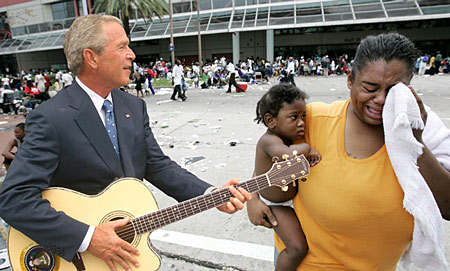
He would have noticed if the majority of these stricken folks had been white and prosperous. But they weren't. Most were black and poor, and thus, to the George W. Bush administration, still invisible.
link
Back it up
So a lesson to the wise: Back up monthly, if not weekly.
Anyway...trying to take it in stride. The last time it happened to me it was much worse.
C U
L8r
Fukuyama: There is everything to be regretted...
We do not know what outcome we will face in Iraq. We do know that four years after 9/11, our whole foreign policy seems destined to rise or fall on the outcome of a war only marginally related to the source of what befell us on that day. There was nothing inevitable about this. There is everything to be regretted about it.
Bush & Co are great teachers...at the barrel of a gun.
Like our own nation's founders over two centuries ago, the Iraqis are grappling with difficult issues, such as the role of the federal government. What is important is that Iraqis are now addressing these issues through debate and discussion -- not at the barrel of a gun.
Ex-squeeze me, what?
So, you invade Iraq and at the barrel of the gun you're trying to promote democracy...and now, Iraq is falling apart thanks to your foolish crew of misfits, yet you have reached new heights of absurdity by claiming this in your weekly audio speech to Americans.
You fool.
You're all fools for continuing to spin sunshine from a dark and grim situation. The world and Americans deserve the truth. THey DESERVE A DOSE OF FRICKIN REALITY. The image I have in my head is one of Bush on a ship. One hole opens up in the bow and water rushes in...he plugs it up with his bullshit. Then another hole and another hole, until he runs out of bs. The ship sinks from unsuccessful bullshit asphyxiation and the sheer force of nature.
And if you wingnuts on the right think you could trample the insurgency like the British did with Malay, you're so sorely mistaken. I'd like to see some wet-behind-the-ears DIA agent in Baghdad learn the numerous Iraqi dialects in 2 years...even 4 years, hell 10 years. I'm sure there are so many capable Americans that could really figure out Iraqi culture and this insurgency... ...in 30-50 years perhaps.
I'm just realistic.
Hope lies in YOU my Iraqi brothers and sisters inside Iraq that are working hard for peace and justice. Not with the fantasy seekers in Washington.
I'm being very very realistic.
Wholesale linkage: Isn't in Iranic, don't you think?
Dept. of WTF: JFK was contemplating using nukes on China if it attacked India again in the sixties.
One of my favorite punk rockers: Billy Childish, a profile
Larry Johnson, former CIA dude interview
Welcome to White America you brown intruders. Again, get demoted for telling the truth. Par for course and simply symptomatic of American unreality. Get promoted and awarded for lying through your teeth, get your life destroyed and get demoted for telling the truth and living in reality.
Inching toward civil war?Eric Lichtblau reported in The Times this week that the administration was dumping the highly respected Lawrence Greenfeld, appointed by President Bush in 2001 to head the Bureau of Justice Statistics, because he refused superiors' orders to delete from a press release an account of how black and Hispanic drivers were treated more aggressively by the police after traffic stops. The Justice Department study showed markedly higher rates of searches and use of force for black and Hispanic drivers, compared with white drivers.
Fearing that the survey would give ammunition to members of Congress who object to using racial and ethnic data in terrorism and law enforcement investigations, Mr. Greenfeld's supervisors buried it online with no press release or briefing for Congress.
Mr. Lichtblau wrote that when Mr. Greenfeld sent the planned press release to the office of his supervisor, Tracy Henke, then an acting assistant attorney general, the section on the treatment of black and Hispanic drivers was crossed out with a notation: "Do we need this?" Ms. Henke herself had added a note: "Make the changes."
It's Frank Rich's Sunday editorial: Iraq, The Vietnam Echo Chamber
Henry Kiss"Um"inger talks Iraq exit strategy
What America doesn't want you to see: A photo gallery and the story.
Timothy M. Phelps: For Basra's Christians, Hussein era the good old days
Shiite-dominated city's minorities say repression on rise It makes me sick to even fathom this topic...that we have made no progress, that women are less free, that smaller minorities such as my family shall remain unprotected by any law, that we should only expect things to worsen for us in Iraq after the constitutional folly of the past week or so. It is ironic, or Iranic I should say, that Iraq has been handed on a platter to Iran by America. Sick, I tell ya, I'm sick.
So sick that I'll actually play hipster bingo.
Welcome to the Jungle
Iraq is the jungle.
Welcome...
Oh, but does it really matter the rule of law has been terminally vexed when people cannot take a stroll in broad daylight without fear of death, air-condition their 50 degree celsius sweat pools, or refrigerate their food?
Nah...so forget about it already.
Liberation is a glorious thing, ain't it?
Bush ally is complete lunatic, not a Christian
1) American Taliban Nutcase 2) Not a Jesus loving Christian
But hey, who am I to judge? Judge yourself.
Hand of Diego

Personally, I think it was a brilliant goal regardless. It's the classic exception to the rule for gamemanship, Maradona-style.
MPG video of the goal

Let's reconstruct the reconstruction
Really? We've made negative progress. Sure, change is painful. In Iraq, though, it's been more than painful. At times, so many things--terrible things--have been happening that I could not begin to fathom the amount and sick quality of death and destruction being visited upon by so many innocent Iraqis. Ordinary Iraqis caught up in a gail storm of gluttonous violence.
So, what next?
Let's reconstruct the reconstruction. Abort the process. Oh, but we can't, you say? Why not? Scrap the whole damn thing, I say. We need more voices heard. Reasonable voices across the spectrum of Iraqi society speaking about realistic and substantive changes being made to the current process which will usher in a gloriously spick-and-span version of the constitution whereby all needs of all parties are satisfied somehow, miraculously. The immaculate conception of Iraqi democracy.
That's what should be next.
Useful links:
Iraq reconstruction and occupation page on Global Security.
10,000 years of history in an Archeological Paradise (don't make you into democrats and republicans)
Bush & Co. help create an Islamic Republic one step at a time
And the Cheney administration is not creating any ordinary Islamic state. They're creating one fraught with deadly militias, just so you know this step in the process better.
Across northern Iraq, Kurdish parties have employed a previously undisclosed network of at least five detention facilities to incarcerate hundreds of Sunni Arabs, Turkmens and other minorities abducted and secretly transferred from Mosul, Iraq's third-largest city, and from territories stretching to the Iranian border, according to political leaders and detainees' families. Nominally under the authority of the U.S.-backed Iraqi army, the militias have beaten up and threatened government officials and political leaders deemed to be working against Kurdish interests; one bloodied official was paraded through a town in a pickup truck, witnesses said.
"I don't see any difference between Saddam and the way the Kurds are running things here," said Nahrain Toma, who heads a human rights organization, Bethnahrain, which has offices in northern Iraq and has faced several death threats.
Iraq war veteran, aspiring politician, Paul Hackett has tapdancing charisma
Love people, not places. Create together, don't destroy each other.
Bush will not meet with a mother of a fallen soldier
And why won't he meet with her? Because he's on vacation...for five weeks. Do you know the average American gets 7 days of vacation? Oh, but the preznit deserves this vacation because of all the successes he's commandeered this last year. With Iraq going so well, he might as well take the whole year off.
I stand by you Ms. Sheehan and all participators in the 1,600 vigils being held across America. I ask the same questions you ask. And I will continue to ask them, no matter how futile the effort may seem.
America and the world owes you a great debt for starting a conversation about the war that I thought would be difficult, if not impossible, to re-ignite so quickly.
You have single-handedly accomplished what troves of protestors could not. And so, I commend you deeply.
UPDATE:
Cindy Sheehan's mother has had a stroke, so she has left Crawford. There are still hundreds of mothers there and more vigils are planned to happen simultaneously across the country on Saturday.
For more on the happenings in Texas where Ms. Sheehan has been having her vigil, please go here and here. Here are some messages for Cindy at EI.
My thoughts are with you and your mother in this difficult time.
Deputy Chief of US mission in Baghdad, Satterfield, implicated in Israeli lobby scandal
Satterfield is not famous for being completely pro-Israeli, but he does have long and close ties with the Washington Institute for Near East Policy...an AIPAC-backed Israeli think tank pushing Israeli policies in Washington.
If he is leaking classified information from the US government to Israel, he could potentially be leaking to Israel from Baghdad. And this will not make Iraqis happy at all.
Lion in a sheep's clothing?
You decide.
And on the other side of the sinister spy game divide is Iran and its obvious victory in Iraq handed to it by Bush Co. The thick of it is explained in detail in this article in Time.
Is Iraq becoming another Lebanon? Another arena for other peoples' wars?
The real question is...
Hasn't it already become this?
You can't eat federalism.
In Real Iraq, it makes no difference. For the "street", Saddam is history, there is no reconstruction and the filth of Abu Ghraib causes no great surprise - because most Iraqis knew all about it months before the West opened its horrified eyes to the pictures.
As for the constitution, I asked an old Iraqi friend what he thought yesterday. "Sure, it’s important," he said. "But my family lives in fear of kidnapping, I’m too afraid to tell my father I work for journalists, and we only have one hour in six of electricity and we can’t even keep our food from going bad in the fridge. Federalism? You can’t eat federalism and you can’t use it to fuel your car and it doesn’t make my fridge work."
An Iraqi's incisive words
' It is remarkable how the "experts" on Iraq ignore the most important section of Iraqi society: the non-tribal millions centred in Baghdad, Basra, Mosul, Kirkuk and some other large cities. These may well belong to tribes and may even be religious, but are totally independent. They regard their Sheikhs [tribal leaders], if they know who they are, almost as a lower cast: Asha'ir (Tribal people) who are considered clumsy, thuggish, and worst of all obeying the tribes rather than following their principles or the country's institutions.
Until the 1980's Iraq enjoyed the best health, education and other governement service, while the tribal areas were, and still are, quite backward and even primitive, while the cities were as advanced as south western Europe. The non-tribal Iraqis, call them Nationalist if you like, have had no place in Bush's Iraq because the Americans promoted tribalism from day one in the hope of controlling Iraq by buying its Sheiks and Mullahs. This policy worked in Afghanistan and Kurdistan
because these are collections of self-ruled tribal areas, and not real countries, but have failed in Iraq's large cities with their complex relationships and mobile population.
These urban Iraqis are critical for the future of Iraq because of their skills and patriotism - do not confuse them with the corrupt Ba'athists though. The Iraqi ministries now are paralysed by the corrupt and incomptent relatives and friends appointed by the Mullahs and Sheikhs who now rule Iraq, which is being transormed into a failed state. The militias and terrorists decide what happens to the people of Iraq. The Constitution and state Institutions are irrelevant no matter how much fuss is made about them.
The Nationalists, who are more likely to be highly educated professionals do not have militias, but can leave the country in droves. Thousands already have, and the country can not function without them regardless of who is in power. The bizzare collection of "Iraq Leaders" today are fighting over spoils that do not exist. The Oil money is not enough even for basic needs, and the failed economy and services will sooner or later trigger national revolt. Unlike other nations, millions of ordinary civilians have AK47s in their homes, and plenty of military training. '
en générale...
I'm desperately busy these days. My studies have become exponentially more difficult. Also, I've gained a number of new responsibilities and I haven't been able to deliver the goods on time. I've had some more problems with my internet connection, but now everything seems to be running soundly. I need to clean up my computer from a number of files not belonging here, too. It continues to be a bumpy ride online due to a packed hard drive. The net result of all these things has been falling more and more behind on everything going on. I'm going to try to catch up in the next couple of days because the weather is pretty nasty out.
One of my priorities is to address Khalid's imprisonment and what we'll work on accomplishing as a result of one of our very own spending time in the terrible conditions of Iraqi prisons. Of course, I am extremely unhappy Khalid and the Jarrars had to go through such a scary time. But I suggest this moment be seized as a blessing in disguise. We might be able to help many others who have been wrongly accused. We need to brainstorm about this in the coming days and weeks. And we need to continue writing those emails, letters, and making those phone calls.
More soon...
Meanwhile, check out Siggraph's cyber fashion show.
Increase the peace,
LIMinal
Chris Matthews says it well.
"If the war in Iraq was going better, we wouldn't still be asking how we got into it. But it isn't, so we are. For some, the deciding argument for going to war with Iraq was self-defense...it was nuclear. If Saddam Hussein had the bomb or was about to [get it], we had to stop him.
How many times were we told the smoking gun would be a mushroom cloud? How many times did the vice president tell us that Iraq had a nuclear program? Who can forget that the President himself used his State of the Union to warn of Saddam cutting a deal down in Africa? It was a smart, shrewd strategy...talking about mushroom clouds. It got people off the fence. It carried the undecideds. It shut down the opposition. It got us into Iraq. But it was based on faulty, bogus evidence.
Two years ago, with our forces fully engaged in Iraq, the nuclear threat was long seen as inoperative. Now a former Ambassador [Joseph Wilson], who had been sent to Africa before the war looking for evidence of an Iraqi uranium deal, said he came back empty. But he wasn't the first to try and knock down the nuclear argument. Intelligence agencies had been doing that for months, just as unsuccessfully.
The larger scandal in this White House/CIA leak story is not just who leaked the name of an undercover agent, but whether we were given a case for war---the deciding factor for many of us---knowing that it didn't hold water. As we work to find our way out of Iraq, we should focus a bit...on how we got in."
The Chris Matthews Show
July 24
Ouch: Cockburn makes it burn.
The war in Iraq is now joining the Boer War in 1899 and the Suez crisis in 1956 as ill-considered ventures that have done Britain more harm than good. It has demonstrably strengthened al-Qa'ida by providing it with a large pool of activists and sympathisers across the Muslim world it did not possess before the invasion of 2003. The war, which started out as a demonstration of US strength as the world's only superpower, has turned into a demonstration of weakness. Its 135,000-strong army does not control much of Iraq.

Não um terrorista = Not a terrorist

Leave computers for a day...
Khalid is free!
Yippeeeeeeeeeeeeee
Sam Cooke & Soul Stirrers: Strike out against the man with song
Hard to un-teach the affects of neocolonialism and Islamic fundamentalism. In an over-simplified nutshell, we're at a point in history where both are just reactions to the other and include effective brainwashing techniques on their most devout members. Cheney and Bin Laden are just human manifestations, salesmen, if you will, of these ideas. If death and violence were the anecdote to our current situation, we'd be well on our way to succcess. You know me, the consummate optimist.
Swing low, sweet chariot
Comin' for to carry me home
Swing low, sweet chariot
Comin' for to carry me home
I looked over Jordan and what did I see
Comin' for to carry me home
A band of angels comin' after me
Comin' for to carry me home
Swing low, sweet chariot
Comin' for to carry me home
Swing low, sweet chariot
Comin' for to carry me home
If you get to heaven before I do
Comin' for to carry me home
Tell all my friends I'm comin' there too
Comin' for to carry me home
Swing low, sweet chariot
Comin' for to carry me home
Swing low, sweet chariot
Comin' for to carry me home
I'm sometimes up and sometimes down
Comin' for to carry me home
But still I know I'm heavenly (freedom) bound
Comin' for to carry me home
Swing low, sweet chariot
Comin' for to carry me home
Swing low, sweet chariot
Comin' for to carry me home
If I get there before you do
Comin' for to carry me home
I'll cut a hole and pull you through
Comin' for to carry me home
Swing low, sweet chariot
Comin' for to carry me home
Swing low, sweet chariot
Comin' for to carry me home
Thanks to the "Liberation" : Iraqi women get Iranian woman's rights
Splendid.
John Dizard: How Ahmed Chalabi conned the neocons

How Ahmed Chalabi conned the neocons
The hawks who launched the Iraq war believed the deal-making exile when he promised to build a secular democracy with close ties to Israel. Now the Israel deal is dead, he's cozying up to Iran -- and his patrons look like they're on the way out. A Salon exclusive.
- - - - - - - - - - - -
By John Dizard


May 4, 2004 | When the definitive history of the current Iraq war is finally written, wealthy exile Ahmed Chalabi will be among those judged most responsible for the Bush administration's decision to invade Iraq and topple Saddam Hussein. More than a decade ago Chalabi teamed up with American neoconservatives to sell the war as the cornerstone of an energetic new policy to bring democracy to the Middle East -- and after 9/11, as the crucial antidote to global terrorism. It was Chalabi who provided crucial intelligence on Iraqi weaponry to justify the invasion, almost all of which turned out to be false, and laid out a rosy scenario about the country's readiness for an American strike against Saddam that led the nation's leaders to predict -- and apparently even believe -- that they would be greeted as liberators. Chalabi also promised his neoconservative patrons that as leader of Iraq he would make peace with Israel, an issue of vital importance to them. A year ago, Chalabi was riding high, after Saddam Hussein fell with even less trouble than expected.
Now his power is slipping away, and some of his old neoconservative allies -- whose own political survival is looking increasingly shaky as the U.S. occupation turns nightmarish -- are beginning to turn on him. The U.S. reversed its policy of excluding former Baathists from the Iraqi army -- a policy devised by Chalabi -- and Marine commanders even empowered former Republican Guard officers to run the pacification of Fallujah. Last week United Nations envoy Lakhdar Brahimi delivered a devastating blow to Chalabi's future leadership hopes, recommending that the Iraqi Governing Council, of which he is finance chair, be accorded no governance role after the June 30 transition to sovereignty. Meanwhile, administration neoconservatives, once united behind Chalabi and the Iraqi National Congress he founded, are now split, as new doubts about his long-stated commitment to a secular Iraqi democracy with ties to Israel, and fears that he is cozying up to his Shiite co-religionists in Iran, begin to emerge. At least one key Pentagon neocon is said to be on his way out, a casualty of the battle over Chalabi and the increasing chaos in Iraq, and others could follow.
"Ahmed Chalabi is a treacherous, spineless turncoat," says L. Marc Zell, a former law partner of Douglas Feith, now the undersecretary of defense for policy, and a former friend and supporter of Chalabi and his aspirations to lead Iraq. "He had one set of friends before he was in power, and now he's got another." While Zell's disaffection with Chalabi has been a long time in the making, his remarks to Salon represent his first public break with the would-be Iraqi leader, and are likely to ripple throughout Washington in the days to come.
Zell, a Jerusalem attorney, continues to be a partner in the firm that Feith left in 2001 to take the Pentagon job. He also helped Ahmed Chalabi's nephew Salem set up a new law office in Baghdad in late 2003. Chalabi met with Zell and other neoconservatives many times from the mid-1990s on in London, Turkey, and the U.S. Zell outlines what Chalabi was promising the neocons before the Iraq war: "He said he would end Iraq's boycott of trade with Israel, and would allow Israeli companies to do business there. He said [the new Iraqi government] would agree to rebuild the pipeline from Mosul [in the northern Iraqi oil fields] to Haifa [the Israeli port, and the location of a major refinery]." But Chalabi, Zell says, has delivered on none of them. The bitter ex-Chalabi backer believes his former friend's moves were a deliberate bait and switch designed to win support for his designs to return to Iraq and run the country.
Chalabi's ties to Iran -- Israel's most dangerous enemy -- have also alarmed both his allies and his enemies in the Bush administration. Those ties were highlighted on Monday, when Newsweek reported that "U.S. officials say that electronic intercepts of discussions between Iranian leaders indicate that Chalabi and his entourage told Iranian contacts about American political plans in Iraq." According to one government source, some of the information he gave Iran "could get people killed." A Chalabi aide denied the allegation. According to Newsweek, the State Department and the CIA -- Chalabi's longtime enemies -- were behind the leak: "the State Department and the CIA are using the intelligence about his Iran ties to persuade the president to cut him loose once and for all."
But the neocons have bigger problems than Chalabi. As the intellectual architects of an "easy" war gone bad, they stand to pay the price. The first to go may be Zell's old partner Douglas Feith. Military sources say Feith will resign his Defense Department post by mid-May. His removal was reportedly a precondition imposed by Ambassador to the U.N. John Negroponte when he agreed to take over from Paul Bremer as the top U.S. official in Iraq. "Feith is on the way out," Iraqi defense minister (and Chalabi nephew) Ali Allawi says confidently, and other sources confirm it. Feith's boss, Undersecretary of Defense Paul Wolfowitz, may follow. Bush political mastermind Karl Rove is said to be determined that Wolfowitz move on before the November election, even if he comes back in a second Bush term. Sources say one of the positions being suggested is the director of Central Intelligence.
In part, the White House political crew is reacting to pressure from the uniformed military, which is becoming a quiet but effective enemy of the neocons. The White House seems to be performing triage to save the political capital of Defense Secretary Donald Rumsfeld and Vice President Dick Cheney, Iraq hawks who have close ties to the neocons. "Rumsfeld and Cheney stay," says an Army officer. "Powell has his guy Negroponte in there. But the neocons are losing power day by day."
Why did the neocons put such enormous faith in Ahmed Chalabi, an exile with a shady past and no standing with Iraqis? One word: Israel. They saw the invasion of Iraq as the precondition for a reorganization of the Middle East that would solve Israel's strategic problems, without the need for an accommodation with either the Palestinians or the existing Arab states. Chalabi assured them that the Iraqi democracy he would build would develop diplomatic and trade ties with Israel, and eschew Arab nationalism.
Now some influential allies believe those assurances were part of an elaborate con, and that Chalabi has betrayed his promises on Israel while cozying up to Iranian Shia leaders. Whether because of intentional deception or a realistic calculation of what the Iraqi people will accept, it's clear that Chalabi won't be delivering on his bright promises to ally a democratic Iraq with Israel. Had the neocons not been deluded by gross ignorance of the Arab world and blinded by wishful thinking, they would have realized that the chances that Chalabi or any other Iraqi leader could deliver on such promises were always remote. In fact, they need have looked no further than the Israeli media: A long piece in Israel's Jerusalem Report magazine published nine days before the war began last year featured Israelis who dismissed Chalabi's promises about Israel as a political ploy, "a means by which to appeal to the Jewish lobby and, in turn, the administration."
"Chalabi has no use for Israel. He knew all along that this was a nonstarter," says Robert Baer, a former CIA field officer who led covert U.S. operations inside Iraq in the mid-1990s aimed at toppling Saddam. "Chalabi knows exactly what Israel stands for in Iraq and in Iran, with or without Saddam. The idea of building the pipeline to Haifa, or rapprochement with Iran ... I'm sure he told [the neocons] these things could happen, that he played to their prejudices and said, 'This is the new Middle East,' but he didn't believe any of it. That's the way Chalabi operates."
"He was willing to ally with anyone to get where he is now, whether it was the neocons, the Israelis or the Iranians," adds Baer. "He wanted back into Iraq and nothing was going to stop him."
It could have been predicted that Chalabi would want to deal with Israel's enemies in Iran. He and his relatives have made that clear. As Iraq's defense minister, Ali Allawi, says, "We have a lot of problems in common with Iran. If we could involve them in a regional security agreement with us, that would be very fruitful." Still, Chalabi's visit to Iran last December and his repeated assertions that peace in Iraq requires peace with Iran first alarmed, then embittered, his old friends.
Chalabi's neoconservative friends, however, seem to have looked away from evidence that the businessman has always allied himself with whomever can help him the most. In the 1980s, Chalabi's scandal-plagued Petra Bank funneled money to Amal, a Shia militia allied with Iran in Lebanon. And according to a former CIA case officer who worked in Iraq, Chalabi had close ties to the Iranian regime when he was in Kurdish Northern Iraq in the mid-1990s trying to foment resistance to Saddam. He even dealt with Saddam himself when the price was right, and initiated a method to finance the dictator's trade with Jordan in the 1980s through his Petra Bank.
Chalabi's Arab admirers say they knew he'd never make good on his promises to ally with Israel. "I was worried that he was going to do business with the Zionists," confesses Moh'd Asad, the managing director of the Amman, Jordan-based International Investment Arabian Group, an industrial and agricultural exporter, who is one of Chalabi's Palestinian friends and business partners. "He told me not to worry, that he just needed the Jews in order to get what he wanted from Washington, and that he would turn on them after that."
Ahmed Chalabi refused to speak to Salon. He has denounced U.N. envoy Brahimi as an "Arab nationalist" and compared the U.S. decision to bring back some former Iraqi soldiers to "allowing Nazis into the German government immediately after World War II." Douglas Feith, Chalabi's longtime ally and sponsor, also declined a request for an interview. Nevertheless, the outline of the new conflict between the Shiite former exile and his erstwhile sponsors is clear, based on interviews with Iraqi officials, U.S. military personnel and intelligence officers, and politically connected Israelis.
The crux of the conflict is Iran, and whether the U.S. should try to make a deal with the Islamic Republic to enlist its support for peace in Iraq. Before and immediately after the war, the neoconservative position was that U.S. empowerment of the long-disenfranchised Shia community would make possible an Iraqi government that would make a "warm peace" with Israel. This in turn would pressure the rest of the Arab world to make a similar peace, without the need to concede land to the Palestinians.
This was, of course, a pipe dream: The Shia community in Iraq, like the Sunni community, is overwhelmingly anti-Israel, and the entire range of its leadership has close ties with Iran. Belatedly realizing that Chalabi's promise to build a secular, pro-Israel Shiite government is not going to come true, in the past couple of months the neocons in the Defense Department have tried to come up with a new plan. Feith, Wolfowitz and others are backing away from the Shia, due to their ties to Iran as well as Chalabi's deceptions. They are trying to cobble together a coalition of rehabilitated Sunni Muslim Iraqi Army officers and Kurdish leaders backed by their militias that would have Shia participation, but in a reduced role. For proponents of this strategy, the front-runner to be prime minister of the next version of the transitional government is Kurdish leader Jalal Talabani, the founder and leader of the Patriotic Union of Kurdistan.
This policy has very little support. It's opposed by those neocons who still back Ahmed Chalabi and his Shia allies -- including influential former Defense Policy Board chair Richard Perle, along with neocon intellectuals Michael Ledeen, Bernard Lewis and Barbara Lerner. Although they like Talabani, they oppose the tilt toward the Sunnis, and some are still adamant that Chalabi play a role. "He's effective in bringing groups of Iraqis together, something he's done for many years," Perle said on CNN on March 28. "He believes in democracy. I have complete confidence in him, and I hope the people of Iraq are wise enough to see his benefits."
The shift in strategy toward Talabani is also being dismissed, for different reasons, by National Security Advisor Condoleezza Rice, Secretary of State Colin Powell, John Negroponte, the new ambassador to Iraq, and the uniformed military. They look at the Iraqi population statistics, which show a Shia majority; a map of the country, which shows a long, hard-to-defend border with Iran; and the U.S. military order of battle, which shows overstretched armed forces, and conclude there cannot be a stable Iraqi government that isn't led by the majority Shia.
Even the Kurds have their doubts about the new rise in their standing with the neocons. Richard Galustian, a British security contractor in Iraq who works closely with the Kurdish authorities, says, "The political elevation of the Kurds within Iraq will be very unpopular with other Iraqis, and will be treated with caution by the Kurdish leaders themselves. Many will be skeptical of the ability of the U.S. administration to sustain and remain consistent in any new relationships." If the Americans can turn on the Shia, the reasoning goes, why couldn't they later turn on the Kurds?
President Bush's ability to impose order on this mess is not obvious, and he doesn't have more than a couple of weeks to figure out a solution. With photographs of U.S. troops torturing and abusing Iraqi prisoners inflaming the Arab world, U.S. casualties soaring, the June 30 date to turn over sovereignty looming and no exit strategy in sight, Bush's Iraq adventure has turned into a deadly mess that seems certain to make the U.S. more at risk from terrorism, not less. Bush brought this trouble on himself by buying into the neocons' interpretation of the dynamics of the Middle East, and into Ahmed Chalabi's plans for Iraq -- maybe most disastrously by buying Chalabi's assurances that a secular government dominated by Israel-friendly Shia was possible. If Bush and the neocons wanted to know about Chalabi's real deal-making nature, the signs were there for them to read. But they didn't want to know.
Chalabi appears to have recognized that the neocons, while ruthless, realistic and effective in bureaucratic politics, were remarkably ignorant about the situation in Iraq, and willing to buy a fantasy of how the country's politics worked. So he sold it to them.
Ahmed Chalabi's family, Shia Muslims from Kut in southern Iraq, has a tradition of working with occupation governments, starting with the regime of the Ottoman Turks in 1638. Chalabi's father, Abdul Haydi Chalabi, was a member of the council of ministers of King Faisal II, whose short-lived Hashemite dynasty was installed by the British in 1921. He was also president of the Iraqi Senate created by the Hashemites.
The Hashemites are Sunni Muslim nobility, originally from a region in today's Saudi Arabia. While they lost their leading position in the Arabian peninsula to the Al Sa'ud family, they were successfully installed as monarchs in both Jordan and Iraq with British support. The Jordanian Hashemites found a base of support in the local Bedouin tribes, and retain power to this day. The Iraqi Hashemite branch, though, was strongly opposed by the local Shia Muslim ayatollahs from the beginning. So in 1922 the Iraqi Shia religious leaders in Najaf issued a fatwa, or decree, forbidding observant Shia from supporting the Hashemites. The Chalabi family wasn't deterred, though. They were among the few Shia to defy the fatwa and support the British-imposed dynasty. They were rewarded with royal patronage, and wound up controlling the flour milling industry in Baghdad and Basra. The fatwa was finally lifted in 1937, and by then the Chalabis had made a fortune.
Ahmed Chalabi was born in 1944. His family reached the peak of its wealth and influence during his childhood. In 1958, though, the Hashemite royals were slaughtered during a military coup d'état, and the Chalabis fled, first to Jordan, then to Britain. Chalabi reportedly still has a British passport.
The highly intelligent Chalabi enrolled at MIT at 16, where he earned a degree in mathematics. He then took a Ph.D. in math at the University of Chicago in 1969. (His thesis was "On the Jacobson Radical of a Group Algebra.") Despite these serious power-geek credentials, Chalabi has always been known as charming, worldly, and a skilled networker. While at Chicago, Chalabi met Albert Wohlstetter, an applied mathematician and one of the founders of the neoconservative movement. Wohlstetter introduced Chalabi to future movement leaders like Richard Perle and Paul Wolfowitz.
After earning his doctorate, Chalabi returned to the Middle East and became a math professor in Beirut. At the time Beirut was the peaceful financial center of the region, and in 1963 Chalabi's family had, along with some local partners, started Mebco, or the Middle East Banking Corp. It was run by Chalabi's brother Jawad. They had also established a Swiss financial company, Socofi, in 1954, as well as a Swiss subsidiary of MEBCO.
As Ahmed Chalabi has told the story, the Jordanian Hashemite crown prince, Hassan bin Talal, persuaded him to start the Petra Bank in Jordan in 1977. Chalabi's associates say the family had given the Jordanian Hashemites some of the assassinated Iraqi Hashemites' overseas assets after the 1958 coup, which no doubt helped smooth the way. The Chalabi family's other banking and financial companies provided further support.
Just after the overthrow of the Shah of Iran, Chalabi seems to have first established his ties with the Iranian Shia theocracy. The new Islamic Republic turned on the shah's former allies in Israel with a vengeance. The Iranian regime set up a substantial intelligence and political apparatus in Lebanon, among the oppressed local Shia.
One of the key Shia institutions in Lebanon was MEBCO in Beirut, which by the 1980s had become a banker for the Shia Amal militia. Amal and Hezbollah were the principal private armies in Lebanon tied to the regime in Iran. Chalabi was placing Petra depositors' money with MEBCO in those years; by the time Petra collapsed in 1989, bank auditors found, the equivalent of $41 million in transactions with MEBCO were on the books. "All the Lebanese banks were divided between political parties and factions," says Hassan Abdul Aziz, a former director at Petra Bank. "MEBCO bank was no different. All the Shia were close to Iran emotionally or otherwise." A former CIA case officer in Lebanon has a less sympathetic view. "This was basically funding a civil war, which meant murders, assassinations, and blowing up Israelis. MEBCO was putting their chips on every square." Iran and the Shite militias were not the only violent elements destabilizing Lebanon in the '70s and '80s, of course. The bloody Israeli invasions of Lebanon, along with later punitive expeditions, inflamed the Shia and other Lebanese.
But Lebanon was not the only venue for the Chalabi family's flexible and innovative approach to international finance. This may come as a surprise to some of Ahmed Chalabi's newer friends, but he helped finance Saddam Hussein's trade with Jordan during the 1980s. Specifically, Chalabi helped organize a special trading account for Iraq at the Jordanian central bank. Due to the problems created by the war with Iran, Saddam Hussein was unable to obtain credit on normal terms. The special account with the Jordanians allowed him to swap oil for necessary imports -- at least Saddam thought they were necessary -- without going through the international credit system. As Hassan Abdul Aziz explains, "Petra was the first to give letters of credit to Iraq, which they did for 23 months before Banco del Lavoro did in 1984. (The Banco del Lavoro scandal involved the provision of U.S. government commodities loans to buy arms for Saddam Hussein.) By 1986 Jordan had $1 billion in annual trade with Iraq this way, and Petra Bank had 50% of the market." It makes the neocons' insistence that Saddam was behind Petra's fall -- and Chalabi's conviction for embezzling and fraud -- even less credible.
After Petra was seized by the Jordanian authorities in August 1989, Chalabi fled Jordan in the trunk of Crown Prince Hassan's car. Chalabi and his family were still wealthy, despite the collapse of their banking empire, but his career in Middle East banking was over. He was now a double exile, from Jordan as well as Iraq, comfortably ensconced in London. Just a year after his fall, though, Saddam Hussein invaded Kuwait. When the subsequent Gulf War weakened but did not topple Saddam, a new possibility beckoned: the return of the Chalabi family to power in Iraq.
Like many people in the Middle East, Ahmed Chalabi may have had the image of the CIA as an all-knowing organization of worldwide puppet masters. If so, he soon learned otherwise. But in the early 1990s the CIA looked like a good prospect to sponsor an anti-Saddam Iraqi exile movement. At the same time, though, Chalabi was also looking to the Islamic regime in Iran for help.
Chalabi and some fellow exiles founded the Iraqi National Congress in 1992. The INC was largely funded by the CIA, which provided part of its support through the Rendon Group, a Washington public relations company that also does international political work for the Department of Defense. The CIA's support for the INC paid for two radio stations, various propaganda operations, and training camps in northern Iraq for Iraqi army defectors. (Northern Iraq, controlled by various Kurdish factions and protected by U.S. air cover, was a safe haven for Iraqi dissidents along with U.S. and allied intelligence operators.)
While Chalabi was perfectly willing to take the CIA's money, he quickly learned that it had become an ineffectual, self-obsessed bureaucracy. "He had absolute, total disdain for D.C.," says one of his former case officers in northern Iraq. "He looked at the Agency, and Rendon, and they flashed incompetence."
The case officer doesn't know precisely when Chalabi developed a deep relationship with the Iranian clerical regime, but it was in place when Chalabi was in northern Iraq in the early '90s. As the case officer recounts it, "He was given safe houses and cars in northern Iraq, and was letting them be used by agents from the Iranian Ministry of Intelligence and Security [Vevak], and the Iranian Revolutionary Guard Corps. At one point he tried to broker a meeting between the CIA and the Iranians."
The same officer says from time to time Chalabi would offer him "intelligence," which the officer would turn down. "I knew it wasn't any good, and he knew I knew. He took the refusal in good humor. We had a good relationship. I like him."
The CIA's relationship with Chalabi came to an end after a failed offensive in March 1995 against Saddam's forces by the small group of INC exiles and the militia of the Patriotic Union of Kurdistan. The CIA had withdrawn the support it had initially offered for the offensive, in what looks like a classic conflict between field officers and desk officers. Chalabi left northern Iraq the next month, and the CIA cut off its funding for the INC. It was at this time that Chalabi turned his attention to the American neoconservatives. The neocons were deeply disturbed by the Israeli government's "land for peace" negotiations with the Palestinians. The usefulness of the West Bank for "defense in depth" was less important than it would have been from the '40s to the '70s, given the increase in Israel's relative technological and military advantage over the Arabs. However, the idea of giving up what Israel's right-wing Likud leaders and some of the neocons themselves believed to be Israel's God-given lands on the West Bank of the Jordan River was anathema to them. The solution to Israel's strategic dilemma, in their view, was to somehow change the Arab governments.
The neoconservative strategy for Israel was laid out in a 1996 paper called "A Clean Break: A New Strategy for Securing the Realm," issued by the Institute for Advanced Strategic and Political Studies in Jerusalem (but written by Americans). The principal authors for the paper were Douglas Feith, then a lawyer with the Washington and Jerusalem firm of Feith and Zell, and Richard Perle, who until last year was the chairman of the Defense Policy Board, an advisory committee for Defense Secretary Rumsfeld
In the section on Iraq, and the necessity of removing Saddam Hussein, there was telltale "intelligence" from Chalabi and his old Jordanian Hashemite patron, Prince Hassan: "The predominantly Shi'a population of southern Lebanon has been tied for centuries to the Shi'a leadership in Najaf, Iraq, rather than Iran. Were the Hashemites to control Iraq, they could use their influence over Najaf to help Israel wean the south Lebanese Shi'a away from Hizbollah, Iran, and Syria. Shi'a retain strong ties to the Hashemites." Of course the Shia with "strong ties to the Hashemites" was the family of Ahmed Chalabi. Perle, Feith and other contributors to the "Clean Break" seemed not to recall the 15-year fatwa the clerics of Najaf proclaimed against the Iraqi Hashemites. Or the still more glaring fact, pointed out by Rashid Khalidi in his new book "Resurrecting Empire," that Shiites are loyal only to descendants of the prophet Muhammad's son-in-law, Ali, and reject all other lineages, including the Hashemites. As Khalidi caustically notes, "Perle and his colleagues were here proposing the complete restructuring of a region whose history and religion their suggestions reveal they know hardly anything about." In short, the Iraqi component of the neocons "new strategy" was based on an ignorant fantasy of prospective Shia support for ties with Israel.
For Ahmed Chalabi, the neoconservatives' support was the key to getting Washington on his side. And Chalabi's leadership, in turn, was key to the neocons' support for the INC. Perle and Feith, along with future Bush administration officials Paul Wolfowitz and Donald Rumsfeld, signed the February 1998 "open letter" to President Clinton, in which they listed nine policy steps that were in the "vital national interest" of the United States. The first of these was "Recognize a provisional government of Iraq based on the principles and leaders of the Iraqi National Congress (INC) that is representative of all the peoples of Iraq." In October 1998, under intense lobbying pressure from the neocons, Congress passed, and President Clinton signed, the "Iraqi Liberation Act," which provided money and U.S. legitimacy for Chalabi's INC, along with six other exile groups.
However, while Chalabi had proven himself as a lobbyist, if not a guerrilla leader, he had a continuous uphill battle with U.S. intelligence agencies, diplomats and the military, who never liked the INC's loose ways with the facts and taxpayer money. This meant that Chalabi had to constantly reinforce his countervailing support from the neoconservatives -- at least until they took power in the Bush administration in 2001, and squashed all dissonant internal voices on Chalabi. That's when Chalabi and his allies stepped up their planning for an American overthrow of Saddam Hussein. Behind the scenes, Chalabi was also detailing for the neoconservatives and their Israeli allies in the Likud party how the INC would take care of Israel.
One of the key promises he made concerned the revival of the Iraq-Israel oil pipeline. The pipeline from the oilfields of Kirkuk and Mosul to Haifa had been built by the British in the late 1920s, and was one of the main targets of the Palestinian Arab revolt in 1936-38. The 8-inch line was finally cut after Israel's independence in 1948. The sections in Arab territory have mostly rusted away or been carted off for scrap. The Israeli section is used as an irrigation pipe. The fully surveyed right of way, though, remains. It could handle a modern, 42-inch pipe, sufficient to supply the Haifa refinery.
With Chalabi's encouragement, the Israeli Ministry of National Infrastructure, which is responsible for oil pipelines, dusted off and updated plans for a new pipeline from Iraq. "The pipeline would be a dream," says Joseph Paritzky, the minister of national infrastructures. "We'd have an additional source of supply, and could even export some of the crude through Haifa. If we could build it, a pipeline would give us stable transport prices. Compare that to tankers; this year their price has almost tripled. We could also avoid problems such as strikes in our ports, which I've had to deal with. But we'd need a treaty with Iraq, and a treaty with Jordan to build the pipeline."
With Chalabi in power in Iraq, either in front or behind the scenes, L. Marc Zell confirms, the neocons were told there would be such a treaty with Iraq. "He promised that. He promised a lot of things."
Just after the U.S. takeover of Iraq, but before the establishment of the Governing Council of which Chalabi would be finance chair, Paritzky was lobbied by INC representatives in a meeting at the Dead Sea Marriott Hotel resort in Jordan. "We had a chitchat about it with the Iraqis, and with the Jordanians. But we couldn't go to the market and raise funds based on chitchat. We would have needed more to go on." Nevertheless, shortly afterward, on April 9, 2003, Paritzky announced a new technical appraisal of the pipeline.
The neocons in the Defense Department, such as Undersecretary of Defense for Policy Douglas Feith, were more optimistic about the pipeline project than Paritzky, who knew too much about the Middle East to be easily enthused by Chalabi's promises. The DOD neocons sent a telegram directly to the Israeli Foreign Ministry, violating protocol in bypassing the State Department, expressing interest and support for the pipeline project. The State Department had been told by the Jordanians that there would be no pipeline unless the Israelis reached a settlement with the Palestinians. The neocons didn't want to hear that. "If the government agreed to a pipeline without a Palestinian settlement," says a Jordanian official, "the monarchy would fall."
In the meantime, having used the neocons to get himself on the Governing Council, Chalabi appointed friends and relatives to key positions in the government. His nephew Salem (Sam) Chalabi, a lawyer, did much of the drafting of the interim constitution. Another nephew, Ali Allawi, was made minister of trade, with responsibility over foreign trade and investment in Iraq (he was later also named defense minister). Other Chalabi nominees went into the Central Bank, the Finance Ministry and the Oil Ministry.
But Chalabi had his eye on the bigger picture. The wealthy exile had visited Tehran before the war, in August 2002 and January 2003. On those trips he met with senior Iranian officials, and with Mohammed Bakr Al-Hakim, the leader of the Supreme Council for the Islamic Revolution in Iraq, the main Shia opposition group. The neoconservatives chose to overlook these visits to a member of the "Axis of Evil." It could be argued that there was no other way to liaise with Iraqi Shia leaders.
Then in December 2003, Chalabi went to Tehran to meet with Hasan Rohani, the head of Iran's Supreme National Security Council. At that meeting, Chalabi said, "The role of the Islamic Republic of Iran in supporting and guiding the opposition in their struggles against Saddam's regime in the past, and its assistance toward the establishment of security and stability in Iraq at present, are regarded highly by the people of Iraq."
U.S. intelligence agencies, along with leading neocons, began to look again at just who Chalabi's real friends might be, especially since Iranian intelligence agents from his old friends at Vevak were known to be active in Iraq. Also, the Israelis began to notice that Chalabi's old promises had been forgotten.
"I just got the bid papers for a $145 million highway project that were put out by the Iraqis, and they had the Israeli boycott language in them," an Israeli in Baghdad told me in March. "Chalabi promised the boycott would be over."
Ali Allawi, the Chalabi nephew in charge of the Ministry of Trade, and now also the minister of defense, calls trade with Israel "a non-starter. We aren't plugged into that network, and as far as I'm concerned they sell things we don't need. As for the boycott. I don't care. What's the matter with it? The U.S. boycotts Cuba, and nobody says anything about it.
"Our future is more to the east, with Iran, and to the south, with the Gulf states. Iran has natural geographic ties to Iraq. I'm not interested in what those neoconservatives at the (Coalition Provisional Authority) have to say about Iran. We don't have sufficient port capacity, for example. We should use the Iranian ports and roads. Iraq should have fundamental economic and trade relations with Iran, and Turkey, as long as they reciprocate, and I think they will." He dismissed the Mosul-Haifa pipeline with a wave of his hand.
Nabil Al Moussa, the deputy minister of planning for the Oil Ministry, confirmed Allawi's position. Asked whether the ministry had any plans for rebuilding the pipeline to Israel, his previous professional courtesy went out the window. "Absolutely not, and never! Don't ever ask us if we will sell oil to Israel, because we never will!"
Told of Allawi's and Al Moussa's reaction, Joseph Paritzky was philosophical, and a little contemptuous of his would-be neocon benefactors. "How naive can these Americans be? What, they thought they had a deal? Didn't they notice they were in the Middle East?" A neocon's reaction to Paritzky was characteristic: "He's a populist asshole who should have kept his mouth shut." But Paritzky obviously understood Middle Eastern politics far better than the neocons.
While the neocons felt they could ignore negative reports on Chalabi from the CIA, the State Department and other bureaucratic enemies, they have a harder time dismissing what comrades like Marc Zell have to say. Nevertheless, for the time being, many are sticking to the Bush strategy of staying on message and never admitting to mistakes. For example, last week, Michael Ledeen, a leading neocon at the American Enterprise Institute, complained in the National Review Online about "the cascade of anti-Chalabi leaks from his many mortal enemies at the Department of State and the Central Intelligence Agency." Changing the message is painful. As one neocon says: "The worst part of all this [Chalabi's betrayal] is that it will be embarrassing to my friends in the Pentagon."
Defense minister Allawi doubts that the neocons will be able to prevail in their plan to replace Shia dominance in the new Iraq with the Sunni-Kurdish coalition. "This is the last stand of the neocons, I think. The U.S. does have a new policy, which is to find a way to leave. That plan isn't the way to do it. I hear Condi Rice's office opposes the idea, and so does Ambassador Negroponte."
"We really don't have any choice," says a former intelligence officer and West Pointer in Iraq. "We have to make a deal, though we probably don't have to deal with Iran directly. We can make it through the Shia clergy in Iraq."
Allawi dismisses Feith and the neocons and what he calls "their grandiose schemes," but adds, "The neocons still have some influence, partly because they have good ties with the Kurds. And Sharon is still the 840-pound gorilla for U.S. policy."
Clearly the neocons are now in the process of retreating and regrouping. The consensus they'd forged among themselves on Iraq policy has dissolved. The massive plans for the democratization of the Middle East are heading for the recycling bin. Meanwhile, Chalabi's hopes for playing a leadership role in Iraq appear to be gone, although the crafty businessman's ability to resurrect himself from the dead should not be underestimated. It should also be noted that Chalabi family members continue to wield power in Iraq, and will likely continue to. For example, defense minister Allawi insists that he is not "in my uncle's entourage. Instead I travel alongside him." The remark can be interpreted to mean that he doesn't take orders from his uncle, and yet they are still close. Allawi has had a rather more conventional business career than that of his uncle, which has helped his political position in Iraq. While an early investor in Petra Bank, he soon parted company with his uncle and the other partners. He went on to become a successful and respectable portfolio manager in London before returning to Iraq last year.
In the end, despite the neocons' best hopes, Iran has emerged as crucial to the administration's desire for a political settlement in Iraq. Governments in the neighboring countries have taken notice of the neocons' big blunder. "The Iranians have proven to be absolutely brilliant in all of this," says a well-connected Jordanian. "They're showing that they're going to be the ones to win this one, and they'll do it with American money and lives."
For his part, Allawi praises what he sees as the U.S. military's new realism about the need for what he calls "a cold peace" with Iran. "There is no way to have stability in Iraq without Iran," he insists. "The U.S. military has been very correct in its contact with Iran at the border, and has never violated the unwritten agreement."
The neocons' Iraq triumph of last year has turned to ashes. Their Likud allies in Israel are bitterly split over Prime Minister Ariel Sharon's plans for the settlements in the territories. They have a coldly hostile Iraqi government coming in the near future. The clerical regime they loathe in Iran has dramatically improved its strategic position. Some of them must be rueing the day they met Ahmed Chalabi, who told them the fairy tales they wanted to hear.
- - - - - - - - - - - -
About the writer
John Dizard is a columnist for the Financial Times.
Send us a Letter to the Editor
Juan Cole: The Iraq war is over, and the winner is... Iran
Hamstrung by the Iraq debacle, all Bush can do is gnash his teeth as the hated mullahs in Iran cozy up to their co-religionists in Iraq.

By Juan Cole
July 21, 2005 | Iraq's new government has been trumpeted by the Bush administration as a close friend and a model for democracy in the region. In contrast, Bush calls Iran part of an axis of evil and dismisses its elections and government as illegitimate. So the Bush administration cannot have been filled with joy when Iraqi Prime Minister Ibrahim al-Jaafari and eight high-powered cabinet ministers paid an extremely friendly visit to Tehran this week.
The two governments went into a tizzy of wheeling and dealing of a sort not seen since Texas oil millionaires found out about Saudi Arabia. Oil pipelines, port access, pilgrimage, trade, security, military assistance, were all on the table in Tehran. All the sorts of contracts and deals that U.S. Vice President Dick Cheney had imagined for Halliburton, and that the Pentagon neoconservatives had hoped for Israel, were heading instead due east.
Jaafari's visit was a blow to the Bush administration's strategic vision, but a sweet triumph for political Shiism. In the dark days of 1982, Tehran was swarming with Iraqi Shiite expatriates who had been forced to flee Saddam Hussein's death decree against them. They had been forced abroad, to a country with which Iraq was then at war. Ayatollah Khomeini, the newly installed theocrat of Iran, pressured the expatriates to form an umbrella organization, the Supreme Council for Islamic Revolution in Iraq (SCIRI), which he hoped would eventually take over Iraq. Among its members were Jaafari and Abdul Aziz al-Hakim. On Jan. 30, 2005, Khomeini's dream finally came true, courtesy of the Bush administration, when the Supreme Council and the Dawa Party won the Iraqi elections.
Jaafari, a Dawa Party activist working for an Islamic republic, had been in exile in Tehran from 1980 to 1989. A physician trained at Mosul, the reserved and somewhat inarticulate Jaafari studied Shiite law and theology as an auditor at the seminaries of Qom. His party, Dawa, was briefly part of SCIRI but in 1984 split with it to maintain its autonomy.
Iraq has a Shiite Muslim majority of some 62 percent. Iran's Shiite majority is thought to be closer to 90 percent. The Shiites of the two countries have had a special relationship for over a millennium. Saddam had sealed the border for more than two decades, but throughout centuries, tens of thousands of Iranians have come on pilgrimage to the holy Shiite shrines of Najaf and Karbala every year. Iraqis likewise go to Iran for pilgrimage, study and trade. Although neoconservatives like Paul Wolfowitz maintained before the Iraq war that Iraqis are more secular and less interested in an Islamic state than Iranians, in fact the ideas of Khomeini had had a deep impact among Iraqi Shiites. When they could vote in January earlier this year, they put the Khomeini-influenced Supreme Council for Islamic Revolution in Iraq in control of seven of the nine southern provinces, along with Baghdad itself.
It was not only history that brought Jaafari to the foothills of the Alborz mountains. The Iraqi prime minister was attempting to break out of the box into which his government has been stuffed by the Sunni Arab guerrilla movement. Jaafari's government does not control the center-north or west of the country and cannot pump much petroleum from Kirkuk because of oil sabotage. Trucking to Jordan is often difficult. The Jaafari government depends heavily on the Rumaila oil field in the south, but lacks refining capability. Iraq lacks a deep water port on the Gulf and needs to replace inland "ports" like Amman because of poor security. An initiative toward the east could resolve many of these problems, strengthening the Shiites against the Sunni guerrillas economically and militarily and so saving the new government.
The last time Iran and Iraq had really warm relations was the mid-1950s. Iraq then had a British-installed constitutional monarchy, and Prime Minister Nuri as-Said was fanatically pro-Western. The CIA had put Mohammad Reza Shah back on the throne in 1953, deposing the democratically elected prime minister, Mohammad Mossadegh (who had angered the United States when he nationalized the Iranian oil industry). In 1955 Said and the shah both signed on to the Baghdad Pact, a U.S.-sponsored security agreement against the Soviet Union and Arab nationalist Gamal Abdel Nasser of Egypt. The pact proved ill-fated, however. A popular revolution overthrew the Iraqi monarchy in 1958, and Nuri's corpse was dragged in the street. Another popular revolution overthrew the shah in 1979. In 1980-1988, Iran-Iraq relations reached their nadir, as Saddam Hussein's Baath Party and Khomeini's Revolutionary Guards slugged it out on battlefields of a dreary horror not seen since World War I. Jaafari's visit was designed to erase the bitter legacies of that war.
Iraq's Eastern Policy does not come without at least symbolic costs. On Saturday, Jaafari made a ceremonial visit to the tomb of Ayatollah Khomeini, on which he laid a wreath. In a meeting with Supreme Jurisprudent Ali Khamenei on Monday, according to the Tehran Times, Jaafari "called the late Imam Khomeini the key to the victory of the Islamic Revolution, adding, 'We hope to eliminate the dark pages Saddam caused in Iran-Iraq ties and open a new chapter in brotherly ties between the two nations.'" The American right just about had a heart attack at the possibility (later shown false) that newly elected Iranian President Mahmoud Ahmadinejad had been among the militants who took U.S. diplomats hostage in 1979. But the hostage takers had been blessed by Khomeini himself, to whom Jaafari was paying compliments.
When Jaafari met the head of the Iranian judiciary, Ayatollah Mahmoud Hashemi Shahrudi, on Tuesday, the two discussed expanding judicial cooperation between the two countries. Shahrudi said that cooperation with Iran's Draconian "justice system" has had a positive impact on other Muslim countries. He called for Iraq to coordinate with something called the "Islamic Human Rights Organization" -- an Orwellian phrase in dictatorial Iran, a state that tortures political prisoners and engages in other acts of brutality. And he urged the Iraqi government to put greater reliance on "popular forces" (local and national Shiite militias) in establishing security.
Jaafari was probably only indulging his clerical host, but his Dawa Party certainly does hope to have Islamic law play a greater role in Iraqi society. The New York Times revealed on Wednesday that the new draft of the Iraqi constitution will put personal status matters, many of them affecting women, under religious courts.
For his polite forbearance as his Iranian hosts boasted of the superiority of their Islamic government and grumbled about all those trouble-making American troops in the Iraqi countryside, Jaafari was richly rewarded. Iran offered to pay for three pipelines that would stretch across the southern border of the two countries. Iraq will ship 150,000 barrels a day of light crude to Iran to be refined, and Iran will ship back processed petroleum, kerosene and gasoline. The plan could be operational within a year, according to Petroleum Minister Ibrahim Bahr al-Ulum, whose father is a prominent Shiite cleric.
In addition, Iran will supply electricity. Iran will sell Iraq 200,000 tons of wheat. Iran is offering Iraq use of its ports to transship goods to Iraq. Iran is offering a billion dollars in foreign aid. Iran will step up cooperation in policing the borders of the two countries. Supreme Jurisprudent Khamenei has called for the preservation of the territorial integrity of Iraq. In fact, Iran is offering so much for so little that it looks an awful lot like influence peddling.
The previous week, Defense Minister Saadoun Dulaimi had made a preparatory trip to Tehran, exploring the possibility of military cooperation between the two countries. At one point it even seemed that the two had reached an agreement that Iran would help train Iraqi troops. One can only imagine that Washington went ballistic and applied enormous pressure on Jaafari to back off this plan. The Iraqi government abandoned it, on the grounds that an international agreement had already specified that out-of-country training of Iraqi troops in the region should be done in Jordan. But the Iraqi government did give Tehran assurances that they would not allow Iraqi territory to be used in any attack on Iran -- presumably a reference to the United States.
Iranian leaders pressed Jaafari on the continued presence in Iraq of the Mojahedin-e Khalq (MEK), an Iranian terrorist organization with ties to the Pentagon, elements in the Israeli lobby, and members of the U.S. Congress and Senate. Saddam had used the MEK to foment trouble for Iran. Jaafari promised that they had been disarmed and would not be allowed to conduct terrorist raids from Iraqi soil.
Not surprisingly, the warming relations between Tehran and Baghdad have greatly alarmed Iraq's Sunni Muslims. They know that Iranian offers of help in training Iraqi security officers, and Iranian professions of support for a united, peaceful Iraq are code for the suppression by Shiite troops and militias of the Sunni Arab guerrilla movement. Many Iraqi Sunnis believe that the Sunni Arabs are the true majority, but that millions of illegal Iranian emigrants masquerading as Iraqi Shiites have flooded into the country, skewing vote totals in the recent elections. This belief, for all its irrationality, makes them especially suspicious of Shiite politicians cozying up to the ayatollahs in Tehran. A recent BBC documentary reported that the Sunnis of Fallujah despise Iraqi Shiites even more than they do the Americans, in part because they code them as Persians (in fact they are Arabs).
Although officials in Washington felt constrained to issue polite assurances that they want good relations between Iraq and Iran, the U.S. State Department, the Central Intelligence Agency, and hawks in the Bush administration all have a grudge against Iran, and would as soon overthrow the mullahs as spit at them. But thanks to the Iraq debacle, that is no longer a viable option. State Department spokesman Sean McCormack revealed the true amount of influence Washington has in Baghdad when he admitted that the Bush administration has not "had a chance" to discuss Jaafari's trip to Iran with the prime minister.
The Iranians hold a powerful hand in the Iraqi poker game. They have geopolitical advantages, are flush with petroleum profits because of the high price of oil, and have much to offer their new Shiite Iraqi partners. Their long alliance with Iraqi president Jalal Talabani gives them Kurdish support as well. Bush's invasion removed the most powerful and dangerous regional enemy of Iran, Saddam Hussein, from power. In its aftermath, the religious Shiites came to power at the ballot box in Iraq, bestowing on Tehran firm allies in Baghdad for the first time since the 1950s. And in a historic irony, Iran's most dangerous enemy of all, the United States, invaded Iran's neighbor with an eye to eventually toppling the Tehran regime -- but succeeded only in defeating itself.
The ongoing chaos in Iraq has made it impossible for Bush administration hawks to carry out their long-held dream of overthrowing the Iranian regime, or even of forcing it to end its nuclear ambitions. (The Iranian nuclear research program will almost certainly continue, since the Iranians are bright enough to see what happened to the one member of the "axis of evil" that did not have an active nuclear weapons program.) The United States lacks the troops, but perhaps even more critically, it is now dependent on Iran to help it deal with a vicious guerrilla war that it cannot win. In the Middle East, the twists and turns of history tend to make strange bedfellows -- something the neocons, whose breathtaking ignorance of the region helped bring us to this place, are now learning to their dismay.
More than two years after the fall of Saddam Hussein, it is difficult to see what real benefits have accrued to the United States from the Iraq war, though a handful of corporations have benefited marginally. In contrast, Iran is the big winner. The Shiites of Iraq increasingly realize they need Iranian backing to defeat the Sunni guerrillas and put the Iraqi economy right, a task the Americans have proved unable to accomplish. And Iran will still be Iraq's neighbor long after the fickle American political class has switched its focus to some other global hot spot.
- - - - - - - - - - - -
About the writer
Juan Cole is a professor of modern Middle Eastern and South Asian history at the University of Michigan and the author of "Sacred Space and Holy War" (IB Tauris, 2002).
Sound Off
Send us a Letter to the Editor
Related stories
And the winner is ... Iran?
Initial election results suggest that Iran could wield major power in newly democratic Iraq -- not exactly what the U.S. hoped for.
By Mitchell Prothero
02/15/05

